
In the boundless dance of the cosmos, where eternal light contends with shadow, a tale of celestial intrigue and earthly destiny unfurled. Birthed in the luminous embrace of the Pleroma, the realm where Aeons twirled in divine harmony, a discordant echo arose. Yaldabaoth, the Demiurge, an entity born from Sophia’s unbridled quest for knowledge, declared with a thunderous voice, “I am God, and there is no other God beside me,” an arrogant claim that resonated through his shadowy creation, a distorted mirror of the true Fullness.
In this realm, sculpted by the whims of the Demiurge, Adam was formed from clay, a lifeless husk, until Sophia, in a cunning maneuver, led Yaldabaoth to breathe life into him. With this breath, unbeknownst to the Demiurge, the divine spark was infused into Adam. Eve, fashioned to be Adam’s companion, carried within her an unperceived depth of wisdom, a secret echo of Sophia’s light, hidden from the eyes of the Demiurge.
The world, however, was plunged into a deeper darkness with Yaldabaoth’s vile act against Eve. It was an act that reverberated through the annals of time, giving rise to two lineages: Cain and Abel, born from violence and shadow, and Seth, born from the union of Adam and Eve, a bearer of the unblemished divine spark.
Seth’s lineage, illuminated in the “Apocryphon of John,” was “begotten in the image of the Father.” His descendants, known as the ‘Sons of Man,’ became the sacred keepers of gnosis, the hidden knowledge of their divine origin. They stood as beacons of hope against the lineage of Cain, who were ensnared in the material world’s illusions, their divine spark obscured by the Demiurge’s machinations.
The narrative spiraled to a cataclysmic crescendo with the great flood, a tempest of Yaldabaoth’s wrath, threatening to extinguish humanity’s divine spark. Noah, a figure of complexity, emerged as the ark’s master, steering the vessel through the deluge. Yet, Noah’s lineage was not of Seth but influenced by the Demiurge. His ark, while preserving life, was not the bastion of the sacred gnosis.
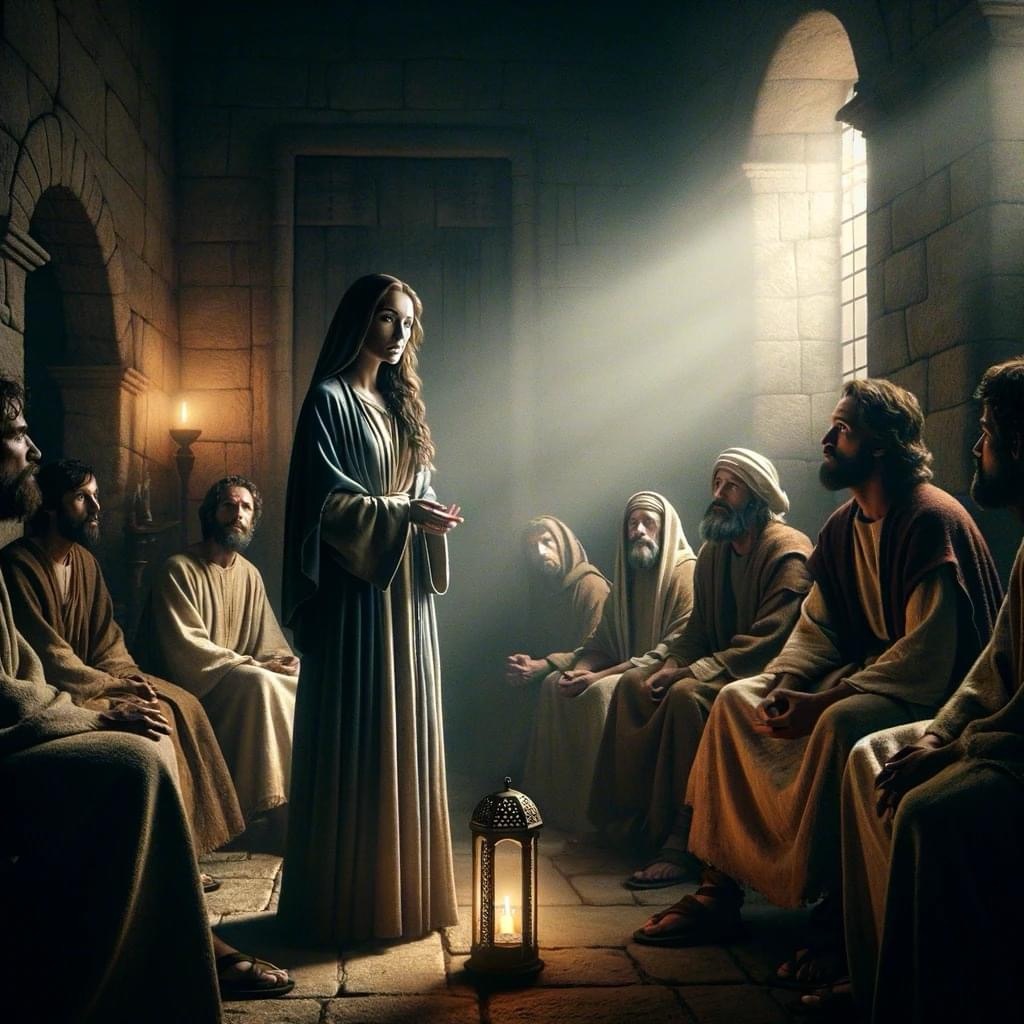
In a divine act transcending the physicality of Noah’s ark, the children of Seth were taken ‘on high,’ lifted above the tumultuous waters. This act of salvation, a preservation of Seth’s lineage, symbolized the enduring protection of the divine gnosis from Yaldabaoth’s fury, a spiritual continuity that defied the flood’s ravaging intent.
As centuries unfolded, the duality of these lineages found a profound embodiment in Mary Magdalene. She emerged as a figure of esoteric wisdom and enlightenment, the spiritual heiress of Sophia’s wisdom. Her presence alongside Yeshua (Jesus), the ‘Son of Man,’ marked an epochal union of hidden wisdom and spiritual illumination. Their teachings, veiled yet profound, carved a path to the Pleroma, to the realm of divine Fullness, offering a beacon of hope for liberation from the Demiurge’s oppressive grasp.
Mary Magdalene, rising from the shrouds of history, stood as a guiding light of Sophia’s wisdom, illuminating the path for the lost divine sparks yearning for awakening. Her journey mirrored the soul’s Gnostic pilgrimage – from the depths of darkness to the pinnacle of enlightenment, from the chains of the material world to the transcendent freedom of the spirit.
Thus, this Gnostic saga, woven into the very fabric of time and existence, narrates a story of cosmic conflict and human endeavor. It is a tale of two lineages – one shrouded in darkness, the other radiant with divine love – each carrying within them the seeds of potential enlightenment. It speaks to the eternal human quest for gnosis, the awakening to our true divine origin, and the longing to return to the ineffable light of the Fullness. It captures the essence of our spiritual odyssey, a journey marked by moments of profound darkness and resplendent light, as humanity navigates the forgotten path back to the Pleroma.
 Apostolic Pentecostal Network
You must be logged in to post a comment.