
The “mystery of the cross,” the mystic crucifixion, was understood by the Gnostic Christians in a fashion far different from the literal historic narrative. For the Gnostics the cross was a symbol of cosmic processes as well as of the crucifixion of the soul in matter and of its regeneration. This is abundantly proved in the Gnostic fragments preserved in The Apocryphal Acts (of John, Andrew, and Peter), and texts discovered among The Nag Hammadi scriptures.
In The Acts of John before Jesus is taken by the Jewish authorities. The Apostles are described as holding one another’s hands so as to make a ring round Jesus, who stands in the midst, and to each he sings, they intone in chorus the sacred word “Amen.”
It is evidently some echo of the Mysteries, and the ceremony is that of a sacred dance of initiation (the round dance of the cross). Followed by the crucifixion in which Jesus describes to Apostole John the mystery of the cross.
~ Now before he was taken by the lawless Jews, who also were governed by the lawless serpent, he gathered all of us together and said: Before I am delivered up unto them let us sing an hymn to the Father, and so go forth to that which lieth before us. He bade us therefore make as it were a ring, holding one another’s hands, and himself standing in the midst he said: Answer Amen unto me. He began, then, to sing an hymn and to say:
(The Hymn of the round dance of the cross not included here)
. . .
~ Thus, my beloved, having danced with us the Lord went forth. And we as men gone astray or dazed with sleep fled this way and that. I, then, when I saw him suffer, did not even abide by his suffering, but fled unto the Mount of Olives, weeping at that which had befallen. And when he was crucified on the Friday, at the sixth hour of the day, darkness came upon all the earth. And my Lord standing in the midst of the cave and enlightening it, said:
“John, unto the multitude below in Jerusalem I am being crucified and pierced with lances and reeds, and gall and vinegar is given me to drink. But unto thee I speak, and what I speak hear thou. I put it into thy mind to come up into this mountain, that thou mightest hear those things which it behoveth a disciple to learn from his teacher and a man from his God”.
And having thus spoken, he showed me a cross of light fixed, and about the cross a great multitude, not having one form, and in it (the cross) was one form and one likeness, and therein was one form and one likeness, and in the cross another multitude, not having one form. And the Lord himself I beheld above the cross, not having any shape, but only a voice: and a voice not such as was familiar to us, but one sweet and kind and truly of God, saying unto me:
“John, it is needful that one should hear these things from me, for I have need of one that will hear. This cross of light is sometimes called the word by me for your sakes, sometimes mind, sometimes Jesus, sometimes Christ, sometimes door, sometimes a way, sometimes bread, sometimes seed, sometimes resurrection, sometimes Son, sometimes Father, sometimes Spirit, sometimes life, sometimes truth, sometimes faith, sometimes grace.
And by these names it is called as toward men: but that which it is in truth, as conceived of in itself and as spoken of unto you, it is the marking-off of all things, and the firm uplifting of things fixed out of things unstable, and the harmony of wisdom, and indeed wisdom in harmony. There are places of the right hand and the left, powers also, authorities, lordships and demons, workings, threatenings, wraths, devils, Satan, and the lower root whence the nature of the things that come into being proceeded.
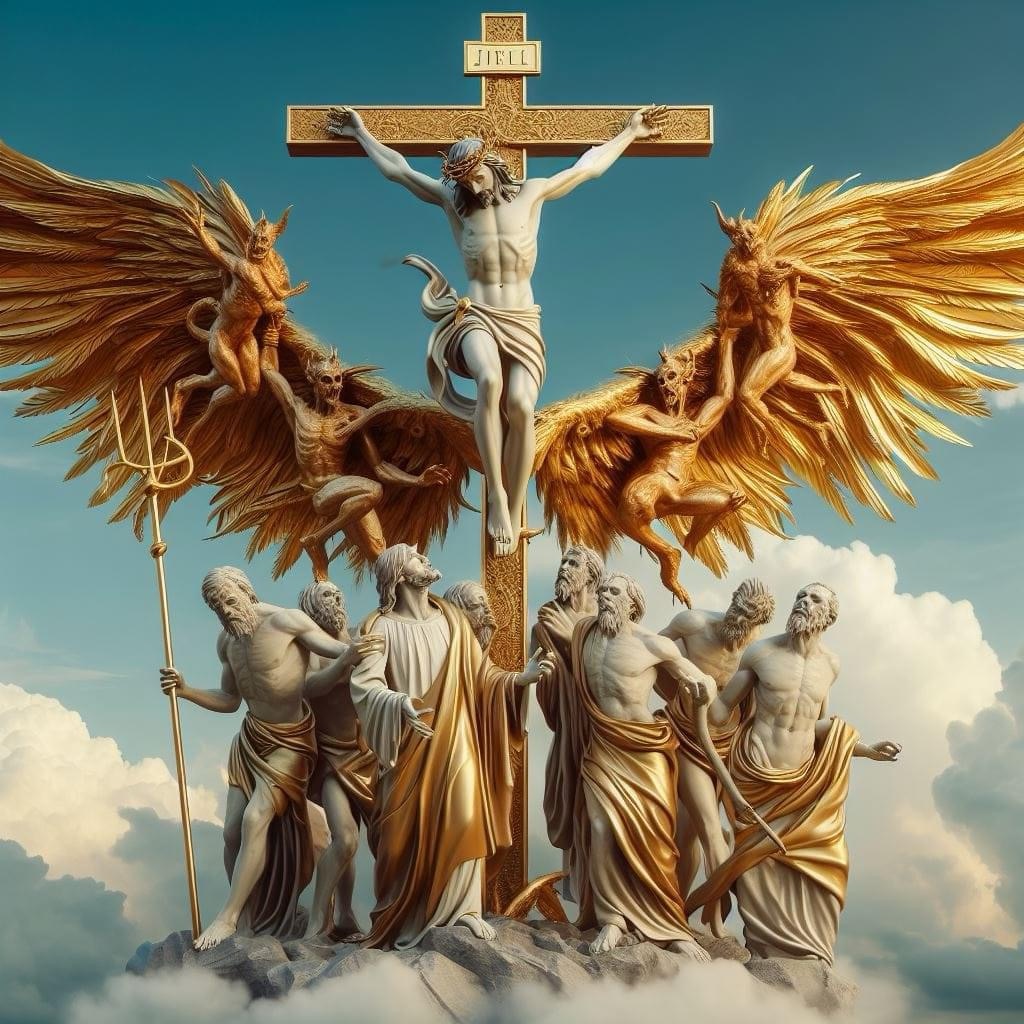
This cross, then, is that which fixed all things apart by the word, and separate off the things that are from those that are below, and then also, being one, streamed forth into all things. But this is not the cross of wood which thou wilt see when thou goest down hence: neither am I he that is on the cross, whom now thou seest not, but only hearest his (or a) voice.
I was reckoned to be that which I am not, not being what I was unto many others: but they will call me something else which is vile and not worthy of me. As, then, the place of rest is neither seen nor spoken of, much more shall I, the Lord thereof, be neither seen.
Now the multitude of one aspect that is about the cross is the lower nature: and they whom thou seest in the cross, if they have not one form, it is because not yet hath every member of him that came down been comprehended. But when the human nature (or the upper nature) is taken up, and the race which draweth near unto me and obeyeth my voice, he that now heareth me shall be united therewith, and shall no more be that which now he is, but above them, as I also now am.
For so long as thou callest not thyself mine, I am not that which I am (or was): but if thou hear me, thou, hearing, shalt be as I am, and I shall be that which I was, when I [have]thee as I am with myself. For from me thou art that (which I am). Care not therefore for the many, and them that are outside the mystery despise; for know thou that I am wholly with the Father, and the Father with me.
Nothing, therefore, of the things which they will say of me have I suffered: nay, that suffering also which I showed unto thee and the rest in the dance, I will that it be called a mystery. For what thou art, thou seest, for I showed it thee; but what I am I alone know, and no man else. Suffer me then to keep that which is mine, and that which is thine behold thou through me, and behold me in truth, that I am, not what I said, but what thou art able to know, because thou art akin thereto.
Thou hearest that I suffered, yet did I not suffer; that I suffered not, yet did I suffer; that I was pierced, yet I was not smitten; hanged, and I was not hanged; that blood flowed from me, and it flowed not; and, in a word, what they say of me, that befell me not, but what they say not, that did I suffer. Now what those things are I signify unto thee, for I know that thou wilt understand.
Perceive thou therefore in me the praising of the Word (Logos), the piercing of the Word, the blood of the Word, the wound of the Word, the hanging up of the Word, the suffering of the Word, the nailing (fixing) of the Word, the death of the Word. And so speak I, separating off the manhood. Perceive thou therefore in the first place of the Word; then shalt thou perceive the Lord, and in the third place the man, and what he hath suffered”.

When he had spoken unto me these things, and others which I know not how to say as he would have me, he was taken up, no one of the multitudes having beheld him. And when I went down I laughed them all to scorn, inasmuch as he had told me the things which they have said concerning him; holding fast this one thing in myself, that the Lord contrived all things symbolically and by a dispensation toward men, for their conversion and salvation.
- The Acts of John
 Apostolic Pentecostal Network
You must be logged in to post a comment.