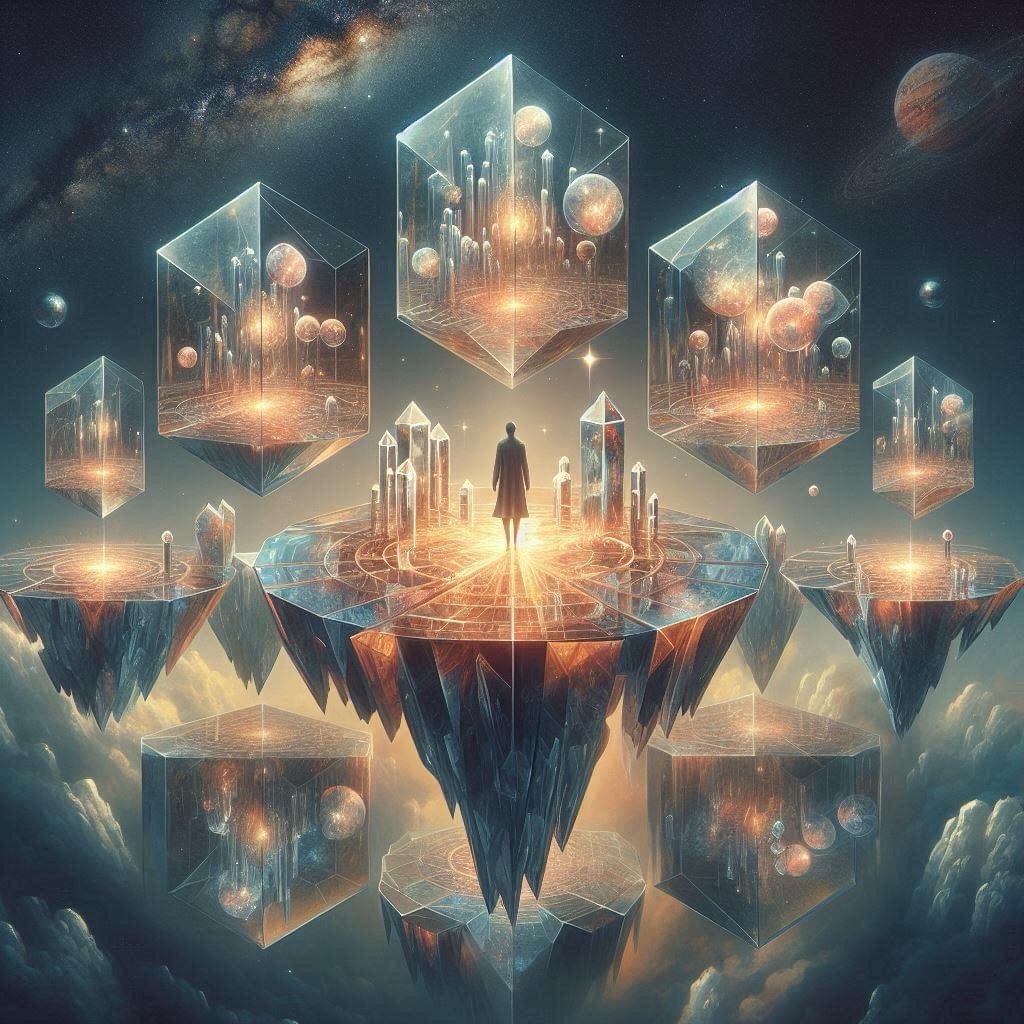
It is in this form that Jehovah is generally pictured by the Qabbalists. The drawing is intended to represent the Demiurgus of the Greeks and Gnostics, called by the Greeks “Zeus,” the Immortal Mortal, and by the Hebrews “IHUH.”
The true name of the Grand Old Man of Israel who is known to history as Moses will probably never be ascertained. The word Moses, when understood in its esoteric Egyptian sense, means one who has been admitted into the Mystery Schools of Wisdom and has gone forth to teach the ignorant concerning the will of the gods and the mysteries of life, as these mysteries were explained within the temples of Isis, Osiris, and Serapis.
There is much controversy concerning the nationality of Moses. Some assert that he was a Jew, adopted and educated by the ruling house of Egypt; others hold the opinion that he was a full-blooded Egyptian. A few even believe him to be identical with the immortal Hermes, for both these illustrious founders of religious systems received tablets from heaven supposedly written by the finger of God.
The stories told concerning Moses, his discovery in the ark of bulrushes by Pharaoh’s daughter, his adoption into the royal family of Egypt, and his later revolt against Egyptian autocracy coincide exactly with certain ceremonies through which the candidates of the Egyptian Mysteries passed in their ritualistic wanderings in search of truth and understanding. The analogy can also be traced in the movements of the heavenly bodies.
It is not strange that the erudite Moses, initiated in Egypt, should teach the Jews a philosophy containing the more important principles of Egyptian esotericism.
The religions of Egypt at the time of the then nomadic people of Israel’s twelve tribes, established in the midst of them his secret and symbolic school, which has come to be known as The Tabernacle Mysteries.
The Tabernacle of the Jews was merely a temple patterned after the temples of Egypt, and transportable to meet the needs of that roving disposition for which the Israelites were famous. Every part of the Tabernacle and the enclosure which surrounded it was symbolic of some great natural or philosophic truth.
To the ignorant it was but a place to which to bring offerings and in which to make sacrifice; to the wise it was a temple of learning, sacred to the Universal Spirit of Wisdom. While the greatest minds of the Jewish and Christian worlds have realized that the Bible is a book of allegories, few seem to have taken the trouble to investigate its symbols and parables.
When Moses instituted his Mysteries, he is said to have given to a chosen few initiates certain oral teachings which could never be written but were to be preserved from one generation to the next by word-of-mouth transmission.
Those instructions were in the form of philosophical keys, by means of which the allegories were made to reveal their hidden significance. These mystic keys to their sacred writings were called by the Jews the Qabbalah (Cabala, Kaballah).
The modem world seems to have forgotten the existence of those unwritten teachings which explained satisfactorily the apparent contradictions of the written Scriptures, nor does it remember that the pagans appointed their two-faced Janus as custodian of the key to the Temple of Wisdom.
Janus has been metamorphosed into St. Peter, so often symbolized as holding in his hand the key to the gate of heaven. The gold and silver keys of “God’s Vicar on Earth,” the Pope, symbolize this “secret doctrine” which, when properly understood, unlocks the treasure chest of the Christian and Jewish Qabbalah.
The temples of Egyptian mysticism (from which the Tabernacle was copied) were—according to their own priests—miniature representations of the universe. The solar system was always regarded as a great temple of initiation, which candidates entered through the gates of birth; after threading the tortuous passageways of earthly existence, they finally approached the veil of the Great Mystery—Death—through whose gate they vanished back into the invisible world.
 Apostolic Pentecostal Network
You must be logged in to post a comment.