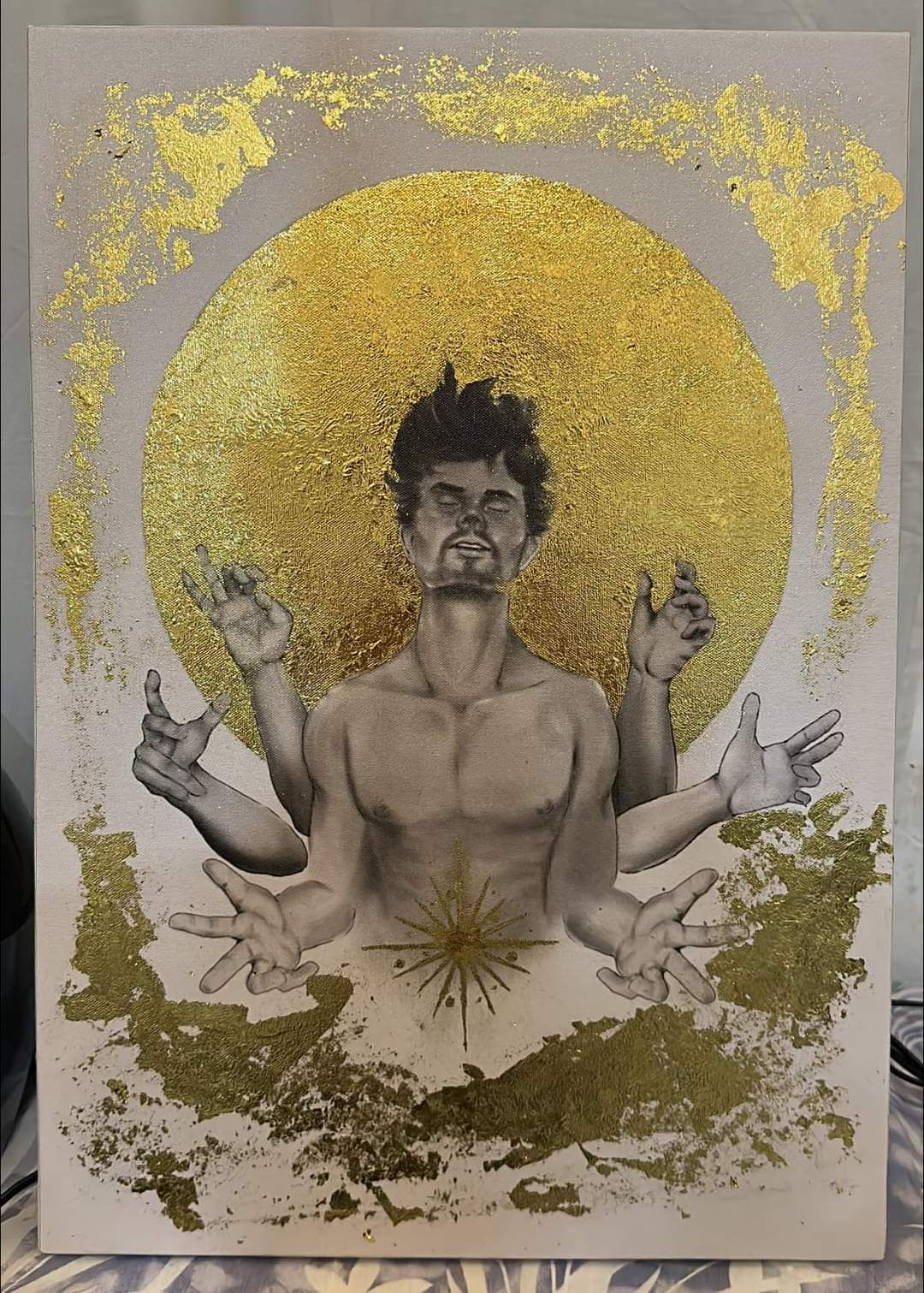
“In Hindu mythology, the awakening of Kali has been described in great detail. When Kali stands up red with anger, all the gods and demons are stunned and everyone becomes silent. They don’t know what she’s going to do. They ask Lord Shiva to pacify her, but Kali roars ferociously throwing him down and standing on his chest, with her mouth open, thirsty for flesh and bone. When the devas perform prayers to pacify Kali, she becomes calm and tranquil. According to yoga philosophy, Kali, the first manifestation of the unconscious, is a terrible power; it completely dominates the individual soul, represented by its position over Lord Shiva. Sometimes it happens that, due to mental instability, some people come into contact with their unconscious body and see fierce and inauspicious elements – ghosts, monsters, etc. When Kali, the unconscious power of man, is awakened, she rises until she meets the further manifestation, the superconscious, the bestower of glory and perfection.”
― Satyananda Saraswati – Kundalini Tantra
Kali (Sanskrit काली), also called Kalika, is a major goddess in Hinduism, primarily associated with time, death and destruction. the black one; time; mind-born ‘divine mother’; a name of the seventh tongue of Agni, the fire god, which was a black fiery flame. Blackness and darkness have always been associated with the pre-cosmic night in its mystical sense, the pralaya preceding the awakening manifestations of life in the present universe.
Kali is the voice of the Divine reverberating within us, when we let our ego fade into the background. Kali is the power of the great current of awareness. Kali is the great Prana or cosmic life-force (Mahaprana). She represents the most primal will of all life, which is to live forever and never die.
Hence kali represents pre-cosmic wisdom. By that strange inversion of fact which nature manifests nearly everywhere, the highest is reflected in the lowest as in a mirror, so that in this sense the black fiery flame is the condensed fiery magnetic vitality of the lowest material worlds; therefore in this sense kali often stands for wickedness and evil. Later, Kali or Kali-Devi became a title of the wife of Siva, Parvati, because of her fierce and destructive nature.
The Kali Yantra:
Kali represents the disintegrative force in nature as displayed in the passage of time and an increase in entropy. Kali is symbolized in the yantra as black. The downward pointing triangle is the ancient symbol of the primal female, the origin of all things – the pubic triangle of the Great Goddess.
In Crossing the Healing Zone: From Illness to Wellness:
“The eight-petal lotus is the eight-fold Prakriti, or nature, consisting of earth, water, fire, air, ether, Manas (mind), Budhi (intellect) and Ahankara (ego). The five triangles are the five Jnanedriyas (Jnana means “knowledge”; indriyas means “the senses”), the five karmendriyas (motor organs), and the five pranas (breathing activities). The bindu at the center is the symbol of balance soul. The five triangles also represent the sacred marriage of the feminine and masculine of your psychological potential. They correlate with a host of sacred symbols, including the Seal of King Solomon, the Seal of Vishnu, the five letters in the name of Jesus and his five wounds, as well as the sacred Pentagram. All five triangles are essentially feminine. They point downward, symbolizing the essence of the Kali yantra as compensating for an excessive masculine drive in the personality.”
“The Kali yantra is invoked when you are dealing with a major life crisis or trauma. It activates the latent code of Kali for the purpose of survival and mastery of an overwhelming situation. The mantra to guide your consciousness through the Kali yantra meditation is Om Kareeng Kalekaye Namah, which means “Salutations to Goddess Kali.”
The four arms of Kālī represent the four directions of space identified with the complete cycle of time. With her four arms, she stands as the symbol of the fulfilment of all and of the absoluteness of her dominion over all that exists.
Kali (काली), also known as Kalika (कालिका), is the Hindu goddess associated with empowerment, Shakti. She is the fierce aspect of the goddess Durga (Parvati). The name Kali comes from Kala, which means black, time, death, lord of death: Shiva. Kala primarily means “time” but also means “black” in honor of being the first creation before light itself. Kali means “the black one” and refers to her being the entity of “time” or “beyond time.” Since Shiva is called Kala — the eternal time — the name of Kali, his consort, also means “Time” or “Death” (as in “time has come”). Hence, Kali is the Goddess of Time and Change.
Kali is strongly associated with Shiva, and Shaivas derive the masculine Kala (an epithet of Shiva) to come from her feminine name.
A nineteenth-century Sanskrit dictionary, the Shabdakalpadrum, states: “Shiva is Kala, thus, his consort is Kali” referring to Devi Parvathi being a manifestation of Devi Maha-Kali.
As the “Satya-Yuga” is always the first in the series of the four ages or Yugas, so the Kali ever comes the last. The Kali-Yuga reigns now supreme in India, and it seems to coincide with that of the Western age. Anyhow, it is curious to see how prophetic in almost all things was the writer of Vishnu Purana when foretelling to Maitreya some of the dark influences and sins of this Kali-Yug.
Kundalini, from circular, spiral + Sakti power, force. The circular power; one of the mystic, recondite powers in the human constitution.
The kundalini, for instance, is likewise born in the Buddhi in man, but descending through the human constitution has its Pranic or psychovital physical representations in the various chakras or vital centers of the human frame, and thus the kundalini is an example of Sakti or of its fluidic effluxes in the lower portions of the human constitution.
The seven sacred planets, or again the seven human principles, form a serpent, often collocated with the sun and moon as making a triad. One form of this spiraling conscious energy, when manifesting in man, is Kundalini-Sakti, the serpentine power, which in the ordinary person today lies relatively sleeping and performing merely automatic vital functions; but when aroused can either waft to sublime heights of vision and power or blast like a lightning-stroke.
The power which a serpent has of casting its old skin is analogous to what the earth does at the commencement of each round, and to the clothing of the human Jiva with a new body when it enters the womb. Again, the astral light is called a serpent; its lowest strata are dangerous and deceptive, while it extends through all planes up to the highest Akasa, the vehicle of divine wisdom.
It is called the ‘Serpentine’ or the annular power on account of its spiral-like working or progress in the body of the ascetic developing the power in himself. It is an electric fiery occult or Fohatic power, the great pristine force, which underlies all organic and inorganic matter; it is Buddhi considered as an active instead of a passive principle (which it is generally, when regarded only as the vehicle, or casket of the Supreme Spirit Atma).
Kundalini works in and through the human auric egg on all levels: in its higher aspect Kundalini is a power or force following winding or circular pathways carrying or conveying thought and force originating in the Higher Triad. Abstractly, in the case of man it is of course one of the fundamental energies or qualities of the Pranas.
“At the end of the Kali, our present age, Vishnu, or the “Everlasting King” will appear as Kalki, and reestablish righteousness upon earth. The minds of those who live at that time shall be awakened, and become as pellucid as crystal. The men who are thus changed by virtue of that peculiar time (the sixth race) shall be as the seeds of other human beings, and shall give birth to a race who shall follow the laws of the Krita age of purity”; i.e., it shall be the seventh race, the race of “Buddhas,” the “Sons of God,” born of immaculate parents.”
― Helena Petrovna Blavatsky – The Secret Doctrine – Volume II
“Christ is always the son of the Divine Mother Kundalini. She always conceives her son through the work and grace of [Saturn] the Third Logos. She is always virginal, before the birth, during the birth and after the birth. Among the Egyptians, the virgin is Isis; among the Hindu, Kali (in her positive aspect); among the Aztecs, Tonantzin. She is Rhea, Cybele, Maria, Adonia, Insoberta, etc.”
 Apostolic Pentecostal Network
You must be logged in to post a comment.