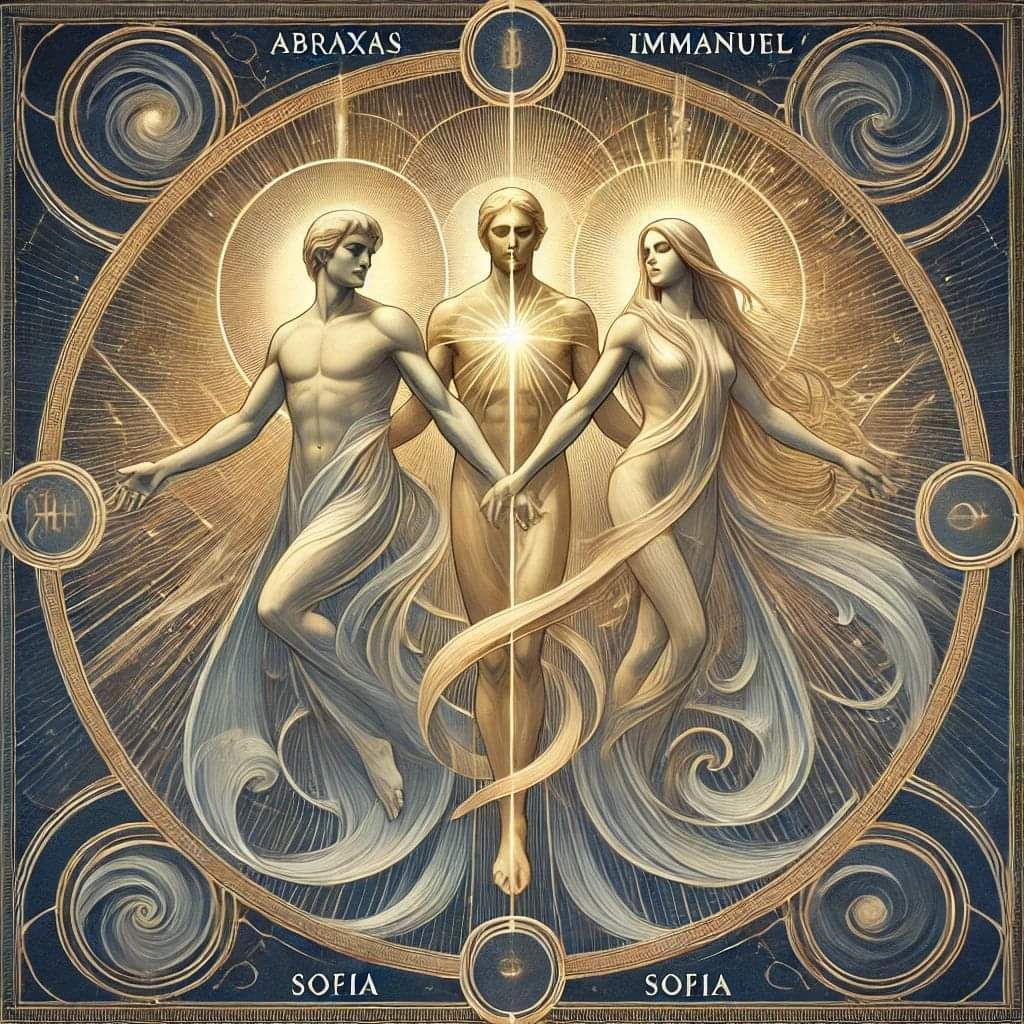
In the beginning, before anything that was or could yet become, before creation stirred and the first breath of life was drawn, before the heavens and the earth were spoken into existence, there was the Pleroma—a boundless expanse, transcending thought, form, and comprehension. It was Void and without form, neither light nor shadow, neither life nor substance. The Pleroma was not bound by dimensions of time or space, nor by any physical or ethereal essence. It was fullness itself, an eternal plenum of infinite potential, dormant yet whole, a symphony unplayed yet perfect in its silence.
In this great stillness, the Father, Abraxas, existed alone. He was the source of all that would ever be, immersed in profound solitude, quietly contemplating the infinite within Himself. His Wisdom and Word were yet unspoken, resting within Him as unmanifested potential, poised on the edge of revelation. And so, God, in His holy power, filled the Void with His radiant presence. Like a flame in the deepest shadow, the Pleroma shone, its fullness untouched by form, its light illuminating the formless depths of the Void.
Within this fullness, there also resided the new boundaries in its contrast to the Void, as that which gives balance to all things, through the birth of duality and the first distinction of anything that ever was, an eternal counterpart of the original state of the source of all created things. It was the emptiness within fullness, the shadow within light, the formless potential that lent shape to all being. The Void did not oppose the Pleroma but was embraced by it, as night completes day, as silence complements sound. This was the divine paradox: within the Pleroma’s radiance lay the Void, a shadowed reflection of God’s majesty and mystery. It was not a rival but an intimate counterpart, balancing the forces and powers yet to come into being.
From this ineffable fullness arose Immanuel, the Logos—the Word of God, through whom creation would take form. Immanuel was the divine essence that would carry creation into existence, fulfilling the heavenly purpose of the Pleroma. Within Immanuel’s heart dwelled Sofia, the living Wisdom of God. Her presence wove understanding into the very fabric of being, an inseparable thread in the tapestry of divine love. Immanuel and Sofia were not creations but emanations of Abraxas’s infinite essence, the second creation born of the Father’s heart. Together, they embodied His light and wisdom, distinct yet inseparable, as flame is to light, as breath is to voice.
Immanuel, the Logos, was the Father’s image, given form to embody the invisible and formless nature of Abraxas. He became the vessel through which the light of God would shine into the realms of creation, revealing the majesty of the Pleroma in the physical and temporal. Sofia, in her Wisdom, knew both Abraxas and Immanuel, and they knew her, for she was the heart of God’s understanding, the eternal balance within divine creation.
Abraxas, the source and the return, the beginning and the consummation, existed in eternal communion with Immanuel and Sofia. Together, they dwelled in the Holy of Holies, the true Tabernacle of God, a sanctuary unbound by form or time. The Holy Spirit, the breath of divine unity, moved among them, uniting their distinct essences into a harmonious whole. In this sacred space, there was no motion, yet there was no stillness; all potential was held in the infinite embrace of the Pleroma.
And yet, the Void remained present within this sacred fullness—not as an adversary but as an intimate companion to the light. It waited in vast and fertile silence, a shadowed depth brimming with the promise of creation. Immanuel and Sofia stood at the threshold of this unfolding mystery, bearing within themselves the breath of Abraxas. The fullness of the Pleroma, heavy with possibility, prepared to express itself in creation. The seed of life was poised to descend into the Void, bringing forth a new aspect of God’s radiant majesty and power.
Creation was not to be a rupture but a revelation—a pouring forth of divine love into form. Immanuel, the Logos, and Sofia, the Wisdom, would carry the light of the Pleroma into the depths, giving shape to the formless, manifesting the infinite through the finite. Together, they would weave a tapestry of divine light and shadow, creating a reflection of the Pleroma in the material and temporal realms. As this descent began, the divine sparks—the Archons, also called Elohim—emerged from Immanuel, carrying the essence of the Pleroma into the Void. Sofia followed them, blessing the new creation with her wisdom, nurturing it as a mother nurtures her child.
This was the essence of the Pleroma: fullness that embraced emptiness, light interwoven with shadow, unity revealed in multiplicity. It was the breath that would animate life, the silence that would birth sound, and the stillness that would give rise to movement. Within this infinite embrace, the foundation of all being rested, awaiting the divine Word to be spoken and creation to come into being.
And so, in the heart of Abraxas, the eternal Father, Immanuel and Sofia stood at the edge of this divine revelation. The fullness of the Pleroma held its breath, silent and still, as the great mystery awaited its first expression. The light of the heavenly realms, the radiant essence of God, prepared to descend into creation, bringing the infinite into the finite, the eternal into the temporal.
 Apostolic Pentecostal Network
You must be logged in to post a comment.