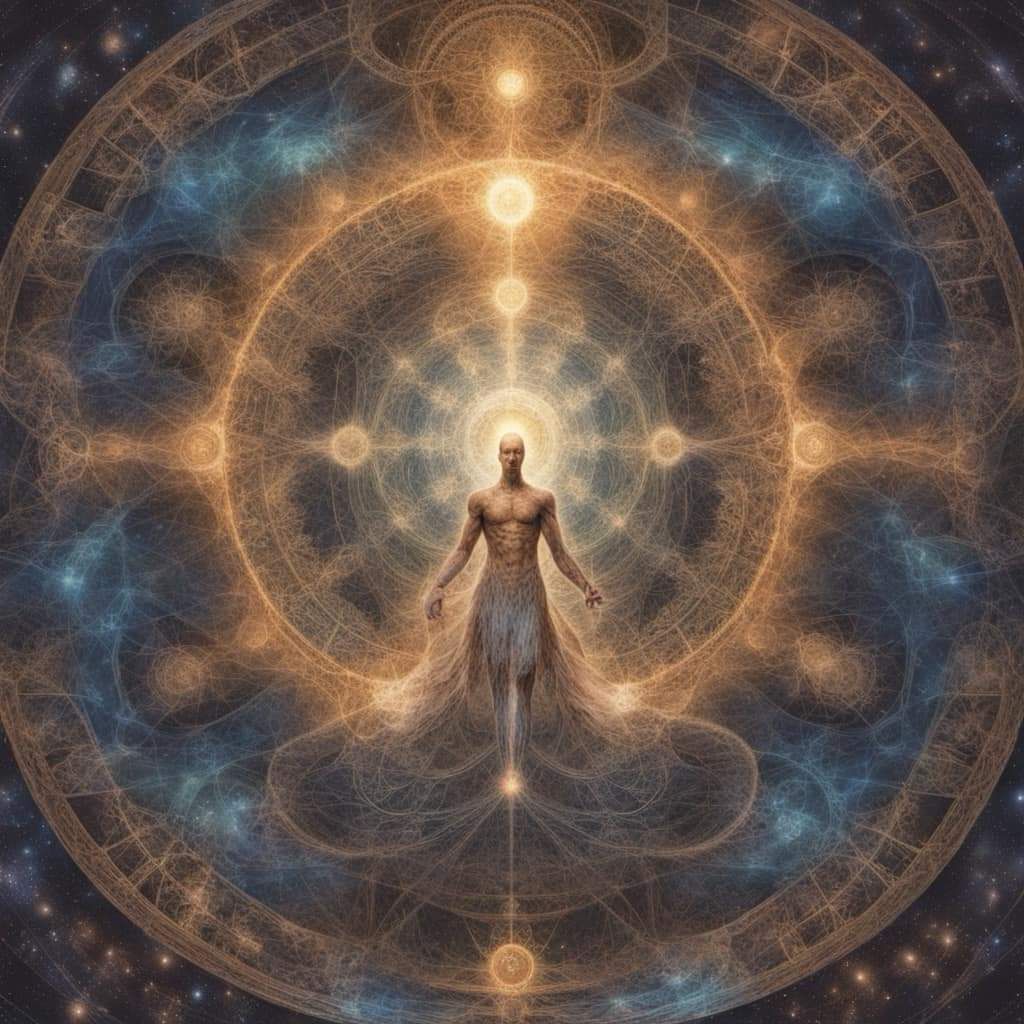
In this world—by which I mean the constructed experience of liberal democracy and its ethos—I have come to recognize a troubling pattern in how religion, spirituality, and God are conceptualized. Religion has been transformed into a social and external commodity, a product of capitalism’s insatiable hunger for consumption. Within this framework, the sacred is commodified, and God is repackaged as a distant entity, a soothing distraction rather than an intimate presence.
Spirituality becomes a salve marketed to anxious souls, offering hollow rituals and tokens that sustain the illusion of divine proximity while fostering a profound estrangement from true spiritual reality. This model perpetuates the myth of an inaccessible heaven, a far-off realm reserved for the dead, where entrance is either granted or denied based on earthly adherence to prescribed formulas. It reduces God to a transactional figure, a cosmic accountant tallying merits and demerits, while leaving the human soul mired in spiritual poverty. Such a view, while archaic in its echoes of medieval Christianity, persists today in a subtler form. The postmodern collapse of meaning has left us clinging to a diluted version of Christ—
a “Consumer Christ” who functions as a personalized Santa Claus for adults, dispensing blessings in exchange for faith and devotion. This Christ resides in frames on walls, in the routine visits to Sunday services, and in the shallow rituals that many perform to maintain appearances. Yet this Christ, for all his superficial appeal, is a hollow image, incapable of delivering the spiritual growth, depth, and awakening that true faith demands. This shallow engagement with God and Christ is the plight of many modern Christians. It was my plight as well. For years, I neither sought to love God with all my heart and soul nor called out to Him with genuine intent. I did not attend church, read the Bible, or pray. I lived disconnected from the profound spiritual conversion I once experienced—a conversion marked by dreams of Jesus, the Holy Spirit, and a divine presence that felt undeniably real. Over time, those memories of transformation faded into distant echoes, remnants of a past I no longer inhabited. I told others of my great spiritual awakening, yet the truth was that I lived far from that moment, disconnected from God, and estranged from the Holy Spirit that once burned so brightly within me.
The Call to Remember. What I failed to realize was that even in this spiritual wilderness, I was being prepared for a deeper, more transformative encounter with God. Through the seeming distance, He was working to draw me back—not merely to the Christ I had once known but to the fullness of Christ that includes Sofia, the Wisdom of God. For those unfamiliar with Gnostic thought, Sofia is not a goddess in the pagan sense but an integral aspect of God's nature. She is Wisdom itself, a divine emanation seated within the Pleroma—the realm of divine fullness, where Christ is both enthroned and enshrined as the Living Word. Sophia, like the Logos, is a radiant emanation of God's light, intimately tied to His nature and purposes. To the truly Christian Gnostic, Sofia is no more pagan than Mother Mary is to a devout Catholic. Just as Mary represents divine love and nurturance, Sofia embodies the divine wisdom and understanding of the Father and Son of the trinity, together they embody that fourth archetype, the Holy Spirit. She is not an idol but a spiritual reality, an archetype that reveals the profound relationship between God’s mind, and heart and His creation.
The Crisis of Faith.
My own journey back to God involved a reckoning with the Consumer Christ I had unwittingly adopted. For years, I lived in the shadow of a faith I no longer practiced, clinging to memories of a spiritual conversion that felt more like a dream than a reality. I spoke of God, but He was not alive in my heart. I recounted my dreams of Jesus, but I did not live in their light. This disconnection is the great irony of modern Christianity. We profess belief in a God who is omnipresent, yet we act as though He is absent. We speak of Christ as the light of the world, yet we stumble in darkness, blind to His presence within us. We venerate the cross and the empty tomb but fail to recognize their significance in our own lives.
The Role of Sophia.
It was through Sofia—God’s Wisdom—that I began to see the depth of my estrangement and the path to reconciliation. Sofia, as the spirit of divine insight, revealed the hollow nature of my faith and the deeper reality to which I was being called. She opened my eyes to the Consumer Christ I had embraced, not to condemn me but to lead me to the Living Christ—the Logos, the Word made flesh, who dwells not in distant heavens but within the human heart. In Gnostic terms, this was a revelation of the Pleroma, the divine fullness that transcends the material world. It was an awakening to the reality that God is not "out there" but "in here," within the psyche and the soul. This revelation is the heart of true Gnosis: a direct, experiential knowledge of God that transforms the self from within.
A New Vision of Christ.
This Christ is not the shallow figure that is depicted like plastic crosses of Jesus in the dollar store, a staple appetite of Consumer Christianity; it's external tokens and trinkets. He is not a benevolent dispenser of blessings or a distant judge in the afterlife, who after the penance of being a good boy or girl for the whole year you are rewarded with your carnal desires. He is the Logos, the Light of the Pleroma, the true and eternal Word that speaks life into being. He is Immanuel, "God with us," not in abstract terms but as a living presence within the soul. To know this Christ is to know Sofia, for in the Father they are inseparable. Sophia is the wisdom that illuminates the path to Christ, and Christ is the light that reveals to the initiate the heart of Sofia herself, her Wisdom. Together, they lead the soul into the fullness of God—a reality that transcends the illusions of the material or carnal world and the hollow rituals of exoteric realms of Consumer Christianity. This journey is not easy. It requires a deep and profound willingness to confront all the false gods we have erected in our minds, to let go of the external tokens and rituals that have come to define our faith, and to embrace the inner work of spiritual transformation and face the false light produced by the Demiurge, within an ego driven fantasy. But it is a journey worth taking, for it leads to the ultimate revelation: that God is not an external deity to be, carved out of stone or wood and worshiped from afar but the very essence of our being, the source and summit of all that is true, good, and close and intimate and so beautiful to the soul and liberating to the ego, of the unconscious mind. In this revelation, the psyche and the soul are united in a single purpose: to know and love God as He truly is, and in so doing, to become what we were always meant to be—reflections of His divine light, bearers of His infinite wisdom, and participants in the eternal life of the Pleroma.
 Apostolic Pentecostal Network
You must be logged in to post a comment.