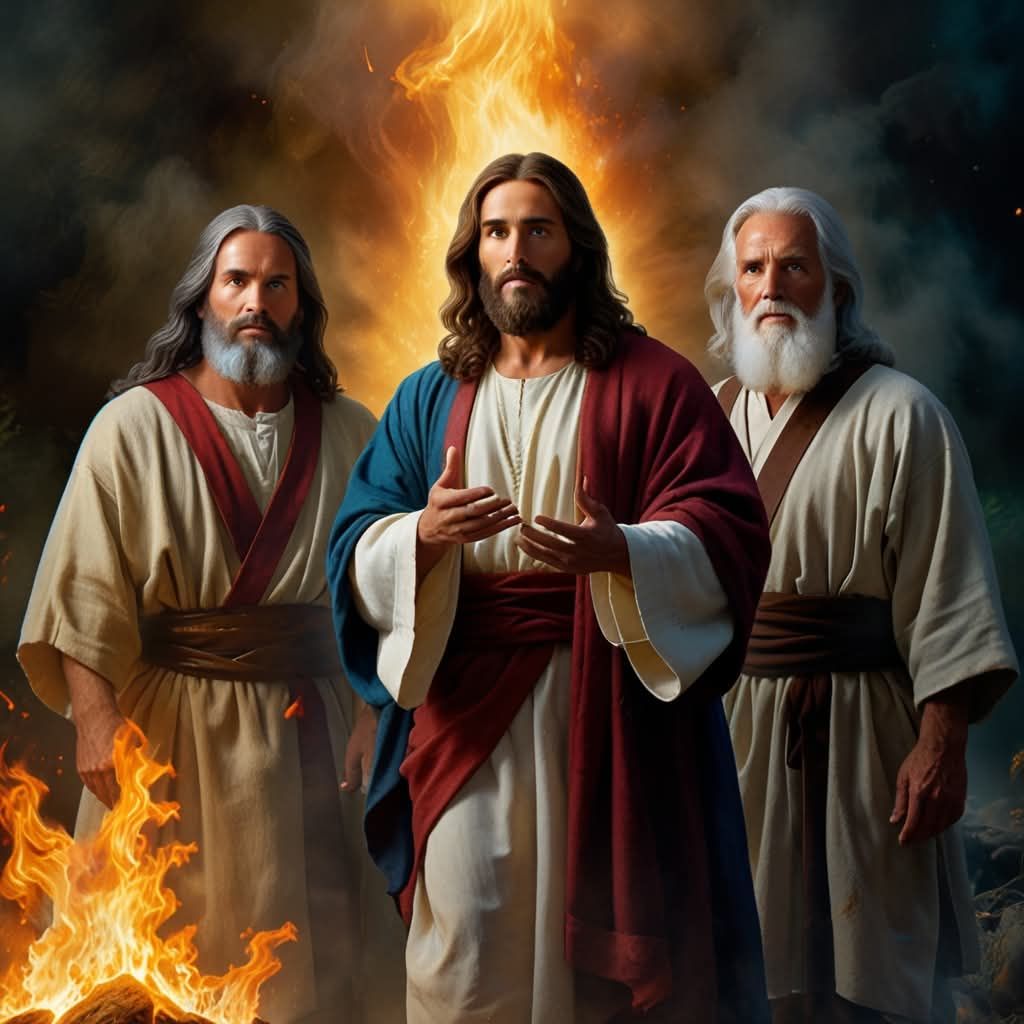
“What is the resurrection? It is always the disclosure of those who have arisen. If you remember reading in the Gospel that Elijah and Moses appeared with Jesus, do not think that the resurrection is an illusion. It is no illusion. It is truth.” Treatise on Resurrection.
Unlike others who engage in pointless discussions about whether the “resurrection” refers to a physical one after death, that is the morbid fantasy of raising from the tomb like a zombie, or a “spiritual one,” that is, getting a brand-new phantasmagoric body “without physical substance,” we are gonna interpret this verse archetypically, so we can actually get some practical learning out of it.
Evidently, the author here is referring to the Transfiguration scene in the synoptic Gospels (Matthew 17:1–8; Mark 9:2–8; Luke 9:28–36). Nevertheless, briefly, we need to clarify the “nature of the resurrection.” Since, in Matthew 17:9 (As they went back down the mountain, Jesus commanded them, “Don’t tell anyone what you have seen until the Son of Man has been raised from the dead.”), the word used for “vision” is the Greek “horama,” which is only used for “supernatural visions,” which rules out any physical, sensible or fleshly “resurrection.”
Furthermore, we should take into account the previous verse in the treatise (“only the living parts that are within will arise”). So, when it comes to the “living parts within,” they refer to the Platonic doctrine of the members of the psyche, that is to say, the “living” parts of the mind that imply cognitive and rational activity. Thus, we have in Plato the tripartite division of the soul, in which the Self should control its rational and irrational sides. Furthermore, this idea of “members of the soul” is amplified in the Timaeus, where the whole cosmos is described as a living being, of which the human soul is a reflection. Nevertheless, the point here is that the tripartite division of the soul is represented in its perfected state in the Transfiguration scene.
When it comes to Moses, he is the archetype of the Lawgiver. So, it would correspond to the Freudian “Superego.” This makes more sense when we consider that the Superego is emanated from the unconscious, whose usual symbol is waters, and coincidentally, Moses literally means “the one who comes out of the waters.” From a Jungian perspective Moses is emanated from the waters of the Collective unconscious, so the “lawgiver archetype” turns, on one side, into the social and cultural influence or rules of the world outside the individual, and on the inner side, it turns into the ancestral genetical inheritance, which would be something like “the psychical programing” of how the individual lives his life, which is something that the individual follows, mostly unconsciously. So by being the “Lawgiver,” the archetype delivers the rules of living and the ways to act in the sensible world. So, this pragmatism would correspond more to the sense side of the intuition/sense syzygy.
We should remember that Moses died before entering the Promised Land. So, if this “Promised Land” is the Self complete, Moses’ necessary death would represent the death of sensible perception, so the psyche could enter the intelligible realm. And also, he was buried by God himself, in a place that no one knows, which means that the Self buried the Superego making it go back into the depths of the unconscious, that’s why no one knows where his body lies.
Nevertheless, there’s a mention in the Epistle of Jude of Satan and the archangel Michael fighting for Moses’ body. So, if Satan represents the sensible perception or the ego-consciousness acting irrationally and in ignorance, and Michael (who is like God), who also fights with Satan in Revelation 12:7-9, represents the intellect, as an archangel (the messengers of the mind), then their fight would represent the attempt of ignorance personified to take over the sensible perception again.
Now, if Moses represents the pragmatic rules of life, especially when it comes to the sensible experience. On the other side, Elijah should represent the intuition side. That is to say, he represents the prophet who can see beyond the material world. That’s why he is elevated in a chariot of fire (2 Kings 2:11), which by being a four-sided symbol, represents the Self complete. So, the Self elevates “intuition” by means of fire, which is a symbol of libido and will.
That Elijah is a “Proto-Logos” figure is clear where he himself is associated with fire. Unlike Moses, who in his interactions with “fire,” it always is as something external to him. So, Moses, by being the sense perception, could only interact with fire, while Elijah is himself the fire (Logos), who as a forerunner of Christ, also brings back someone from the dead. In this case, the son of the widow (a pre-Sophia figure who has no husband and whose son (her conceived ideas) died).
Thus we find this verse praising the fire (Logos) of Elijah: “Then Elijah arose, a prophet like fire, and his word burned like a torch.” (Sirach 48:1).
For Elijah is said to be a forerunner of the day of the Lord (Malachi 4:5) or the Messiah. So by representing the intuition side of the mind, which is able to perceive beyond appearances, he foreruns the completion of the Self, which is represented by Christ.
Furthermore, it’s important to recall that Elijah and Moses, as archetypal representation are not simply random literacy choices. Rather, as Jung writes in a letter:
“an archetype becomes active and chooses itself when a certain lack in the conscious sphere calls for a compensation on the part of the unconscious. What is lacking on the conscious side is the immediate relation with God: in so far as Elijah is an angelic being fortified with divine power, having the magic name of Eli-YHWH, delivered from corruptibility, omniscient and omnipresent, he represents the ideal compensation not only for Christians but for Jews and Muslims also. He is the typical theos anthropos, more human than Christ inasmuch as he is begotten and born in peccatum originale, and more universal in that he included even the pre-Yahwist pagan deities like Baal, El-Elyon, Mithras, Mercurius, and the personification of Allah, al-Khadir.” (Collected Works of C. G. Jung, Vol. 18).
So, it’s unlikely for the author/s to have chosen to represent those characters in the way they’re portrayed consciously. Rather, they were a manifestation of their own psyche. Since, in the case of Elijah, for instance, it comes from the psychical need of having a closer relationship with God, that is with the Self.
So, having explained that the transfiguration actually represents the synthesis in Jesus of the opposite sides of the syzygy, in this case intuition/sense, we need to go back to the interpretation of the verse in this treatise.
The author mentioned that the “resurrection is the disclosure of those who have arisen.” He mentions the transfiguration scene as proof that those who are no more in the world (the sensible realm) are still alive, for they have arisen. In this case, those figures represent the psychical instances that have arisen to a superior consciousness. Nevertheless, the author warns that resurrection is not an illusion, as the word used in the Gospel implies. Now, here “illusion” should not be interpreted as something “false,” at least not completely. Rather, it should be understood as an appearance, likeness or shadow. So, the vision bears a likeness of resurrection, but the resurrection transcends that illusory vision. Since the vision is just a symbol which it’s supposed to lead to a superior interpretation level, which is only reached by the intellect. For this is the Truth that is veiled in symbols in the vision of the transfiguration.
 Apostolic Pentecostal Network
You must be logged in to post a comment.