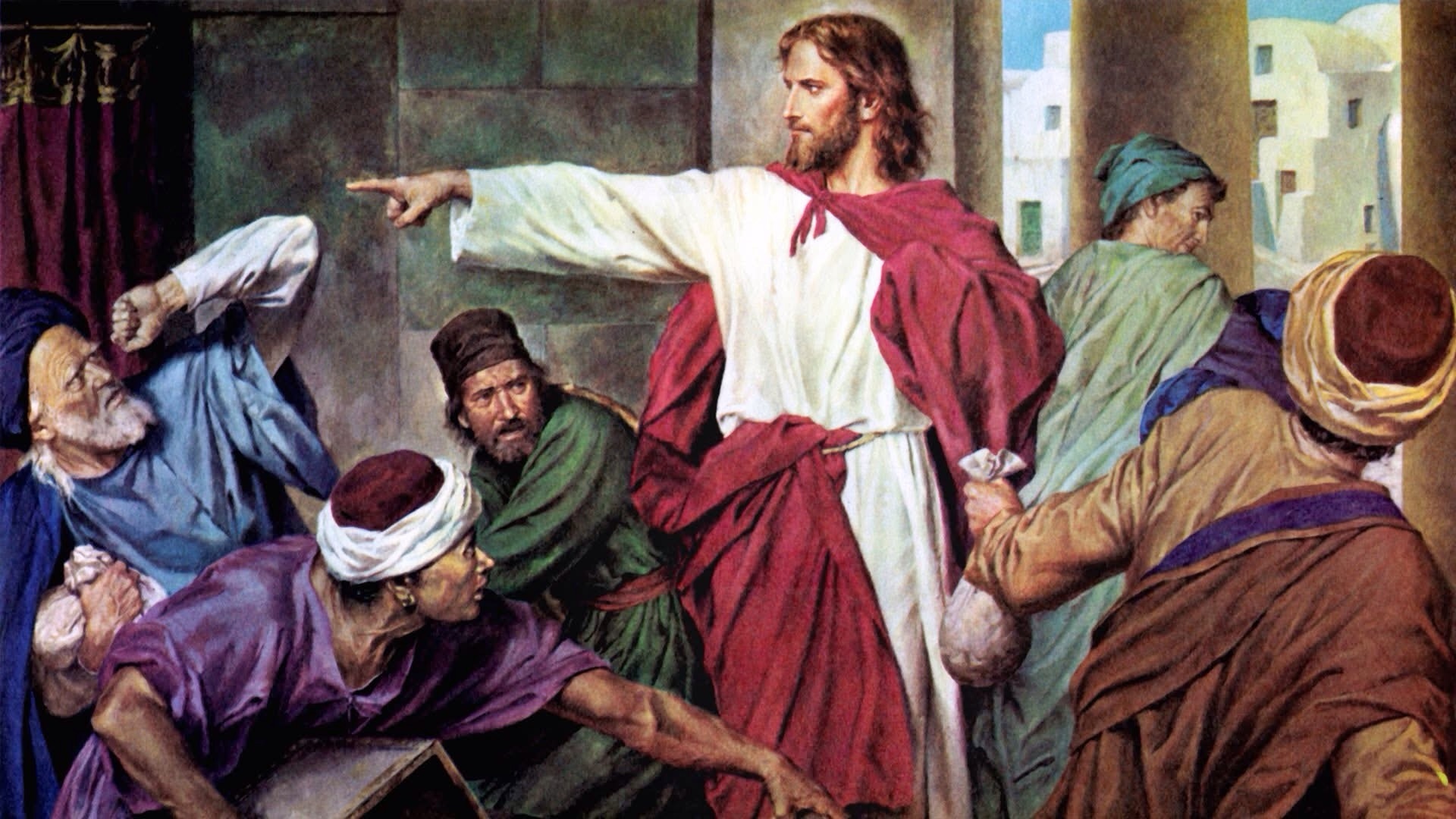
Jesus was an Essene who preached that the Jews (Pharisees and Saducees) did not worship El, the original Semitic God of the ancient Hebrews; but instead worshiped El’s son Yahweh (Satan), who deceived Moses into converting the Israelites to follow Yahweh (Satan) instead of El. This is why Jesus declared that the Pharisee and Saducee Jews were of the devil in John 8:44, saying to them: “You are of your father the devil, and the desires of your father you will do. He was a murderer from the beginning, and stood not for truth, because there is no truth in him. When he speaks a lie, he speaks of his own: for he is a liar, and the father of it.”
Unlike the Jews (the Pharisees and Saducees), the Essenes rejected the Books of Moses as false, and instead followed the Book of Enoch which was among the Biblical texts preserved by the Essenes in their collection of scriptures found among the Dead Sea Scrolls. Unlike the Jewish sects, the Essenes did not offer animal sacrifices, they practiced baptism, believed in pacifism, charity, and lived communally rejecting personal wealth and sharing their meager resources as a group. Many also chose celibacy, and devoted themselves to lives of piety and study. The Essenes accepted Jesus as the Messiah and became known as the Gnostics, who were persecuted out of existence by the second century AD.
The Jews (Pharisees and Saducees) wanted Jesus executed because he was pointing out the fact that they didn’t worship the Hebrew God, El, but instead worshiped Yahweh/Satan. This is what is meant by Corinthians 4:4, which says of the Jews and their “god” Yahweh:
“Satan, who is the god of this world, has blinded the minds of those who don’t believe. They are unable to see the glorious light of the Good News. They don’t understand this message about the glory of Christ, who is the exact likeness of God.”
The Essenes disappeared as a religious sect by the end of the first century A.D. having evolved into the Gnostics, who were persecuted out of existence by the early Christian church established by the Jew Saul (aka Paul) of Tarsus, who took the legends that were circulating about Jesus (a man he had never even met) and meshed them together with Judaism to make Jesus into a magical deity, the “only begotten son” of the Jews’ adopted black African deity Yahweh, who Jesus and his fellow Essenes condemned as the devil.
Flavius Josephus, a Romanized Judean historian born in Jerusalem 37 AD, wrote what is arguably the most detailed contemporary account of the Essenes left to us from ancient history:
“The sect of the Essenes maintain that Fate governs all things, and that nothing can befall man contrary to its determination and will. These men live the same kind of life which among the Greeks has been ordered by Pythagoras.
The Essenes are Judeans by race, but are more closely united among themselves by mutual affection, and by their efforts to cultivate a particularly saintly life. They renounce pleasure as an evil, and regard continence and resistance to passions as a virtue. They disdain marriage for themselves, being content to adopt the children of others at a tender age in order to instruct them. They do not abolish marriage, but are convinced women are all licentious and incapable of fidelity to one man.
They despise riches. When they enter the sect, they must surrender all of their money and possessions into the common fund, to be put at the disposal of everyone; one single property for the whole group. Therefore neither the humiliation of poverty nor the pride of possession is to be seen anywhere among them.
They regard oil as a defilement, and should any of them be involuntarily anointed, he wipes his body clean. They make a point of having their skin dry and of always being clothed in white garments.
In their various communal offices, the administrators are elected and appointed without distinction offices. They are not just in one town only, but in every town several of them form a colony. They welcome members from out of town as coequal brothers, and even though perfect strangers, as though they were intimate friends. For this reason they carry nothing with them when they travel: they are, however, armed against brigands.
They do not change their garments or shoes until they have completely worn out. They neither buy nor sell anything among themselves. They give to each other freely and feel no need to repay anything in exchange. Before daybreak they recite certain ancestral prayers at dawn as the sun rises.
They work until about 11 A.M. when they put on ritual loincloths and bathe for purification. Then they enter a communal hall, where no one else is allowed, and eat only one bowlful of food for each man, together with their loaves of bread. They eat in silence. Afterwards they lay aside their sacred garment and go back to work until the evening. At evening they partake dinner in the same manner.
During meals they are sober and quiet and their silence seems a great mystery to people outside. Their food and drink are so measured out that they are satisfied but no more. They see bodily pleasure as sinful. On the whole they do nothing unless ordered by their superiors, but two things they are allowed to do on their own discretion: to help those ‘worthy of help’, and to offer food to the needy. They are not allowed, however, to help members of their own families without permission from superiors.
They are very careful not to exhibit their anger, carefully controlling such outbursts. They are very loyal and are peacemakers. They refuse to swear oaths, believing every word they speak to be stronger than an oath. They are scrupulous students of the ancient literature. They are ardent students in the healing of diseases, of the roots offering protection, and of the properties of stones.
Those desiring to enter the sect are not allowed immediate entrance. They are made to wait outside for a period of one year. During this time each postulant is given a hatchet, a loincloth and a white garment. The hatchet is used for cleanliness in defecation for digging and covering up the hole. Having proved his consistence during the first year he draws closer to the way of life and participates in the purificatory baths at a higher degree, but he is not yet admitted into intimacy. His character is tested another two years and if he proves worthy he is received into the company permanently.
They are sworn to love truth and to pursue liars. They must never steal. They are not allowed to keep any secrets from other members of the sect; but they are warned to reveal nothing to outsiders, even under the pain of death. They are not allowed to alter the ‘books of the sect, and must keep all the information secret, especially the names of the angels. The name of the Lawgiver [Noah the source of the Noahide Laws, rather than Moses whose laws the Essenes dismissed as false], after God, is a matter of great veneration to them; if anyone blasphemed the name of the Lawgiver he was sentenced to death. Those members convicted of grave faults are expelled from the order. In matters of judgement Essene leaders are very exact and impartial. Their decisions are irrevocable.
They are so scrupulous in matters pertaining to the Sabbath day that they refuse even to defecate on that day, They always give way to the opinion of the majority, and they make it their duty to obey their elders. They are divided into four lots according to the duration of their discipline, and the juniors are so inferior to their elders that if the latter touch them, they wash themselves as though they had been in contact with a stranger.
They despise danger: they triumph over pain by the heroism of their convictions, and consider death, if it comes with glory, to be better than the preservation of life. They died in great glory amidst terrible torture in the war against the Romans. They believe that their souls are immortal, but that their bodies are corruptible. They believe the soul is trapped in the body and is freed with death. They believe that there is a place ‘across the ocean’ where just souls gather, a place reserved for the immortal souls of the just. The souls of the wicked, however, are relegated to a dark pit, shaken by storms and full of unending chastisement. Some of the Essenes became expert in forecasting the future.
The Essenes declare that souls are immortal and consider it necessary to struggle to obtain the reward of righteousness. They send offerings to the Temple, but offer no sacrifices since the purifications to which they are accustomed are different. For this reason, they refrain from entering into the common enclosure, but offer sacrifice among themselves. They are holy men and completely given up to agricultural labor.”
The Book of Acts, chapter 6, reveals that Jesus and his disciples were Essenes in that they rejected the doctrine of Moses and his negro wife’s African deity, Yahweh, who the Pharisees and Saducees worshiped as their God:
“So the word of God continued to spread. The number of disciples in Jerusalem grew rapidly, and a great number of priests became obedient to the faith.
Now Stephen, who was full of grace and power, was performing great wonders and signs among the people. But resistance arose from what was called the Synagogue of the Freedmen, including Cyrenians, Alexandrians, and men from the provinces of Cilicia and Asia. They began to argue with Stephen, but they could not stand up to his wisdom or the Spirit by whom he spoke.
Then they prompted some men to say, “We heard Stephen speak words of blasphemy against Moses and against Yahweh.” So they stirred up the people and elders and scribes. They seized Stephen and brought him before the Sanhedrin.
They presented false witnesses who said, “This man never stops speaking against this holy place and against the law. For we have heard him say that Jesus of Nazareth will destroy this place and change the customs that Moses handed down to us.”
Angels or Malak (“messengers”), the benei Elohim (“sons of God”)
The Essene religion that Jesus followed was in some ways a precursor to concepts found in Roman Catholicism.
The Essenes believed that Satan (aka Yahweh) has dominion over the material world that humans are trapped in and made to suffer in during our lifetime, while El Elyon (God the Most High) ruled over the ethereal realm, and did not directly concern himself with the corrupt material world that his malignant son Yahweh/Satan ruled over.
In order to get God (El) to pay attention and possibly intervene on behalf of human concerns here in the material realm, an appeal to heaven could be made through the angels (or malak “messengers”) who were the Benei Elohim (“sons of God”).
The intercession of the angels who plead with El (God) to intervene in the affairs of the corrupt material world is a concept set forth in the Book of Enoch, where the angels implore God (El) to set the world right after it had been turned into a disaster due to the giants or Nephilim who were born out of the illicit union between a group of angels who took human women as their wives, as mentioned in Genesis 6:4.
The resulting giants or Nephilim who were born to them became a blight upon the earth by devouring both men and beasts, wrecking havoc upon the planet, motivating the angels to beseech the Almighty to intervene, which he did by sending the flood that wiped out the Nephilim and everything else except those aboard Noah’s ark.
The Essenes preserved the Book of Enoch among their library of religious texts known as the Dead Sea Scrolls, and we know from descriptions of the Essenes given by Josephus and others that they concerned themselves with the angels, knowing that they alone could act as intercessors between humans and El (God).
So the Catholic tradition of praying to saints to act as intermediaries between humans and God is most likely derived from the Essene tradition of appealing to angels. Something that the Elizabethan ceremonial magician Dr. John Dee also seems to have experimented with in his Enochian angel magic.
It may also explain why the Catholic Church decided to omit the Book of Enoch from the dozens of different religious texts that they selected from when compiling the various scriptures that they chose to include in the Bible, as the Catholic Church evidently preferred its followers to pray to saints rather than to angels.
 Apostolic Pentecostal Network
You must be logged in to post a comment.