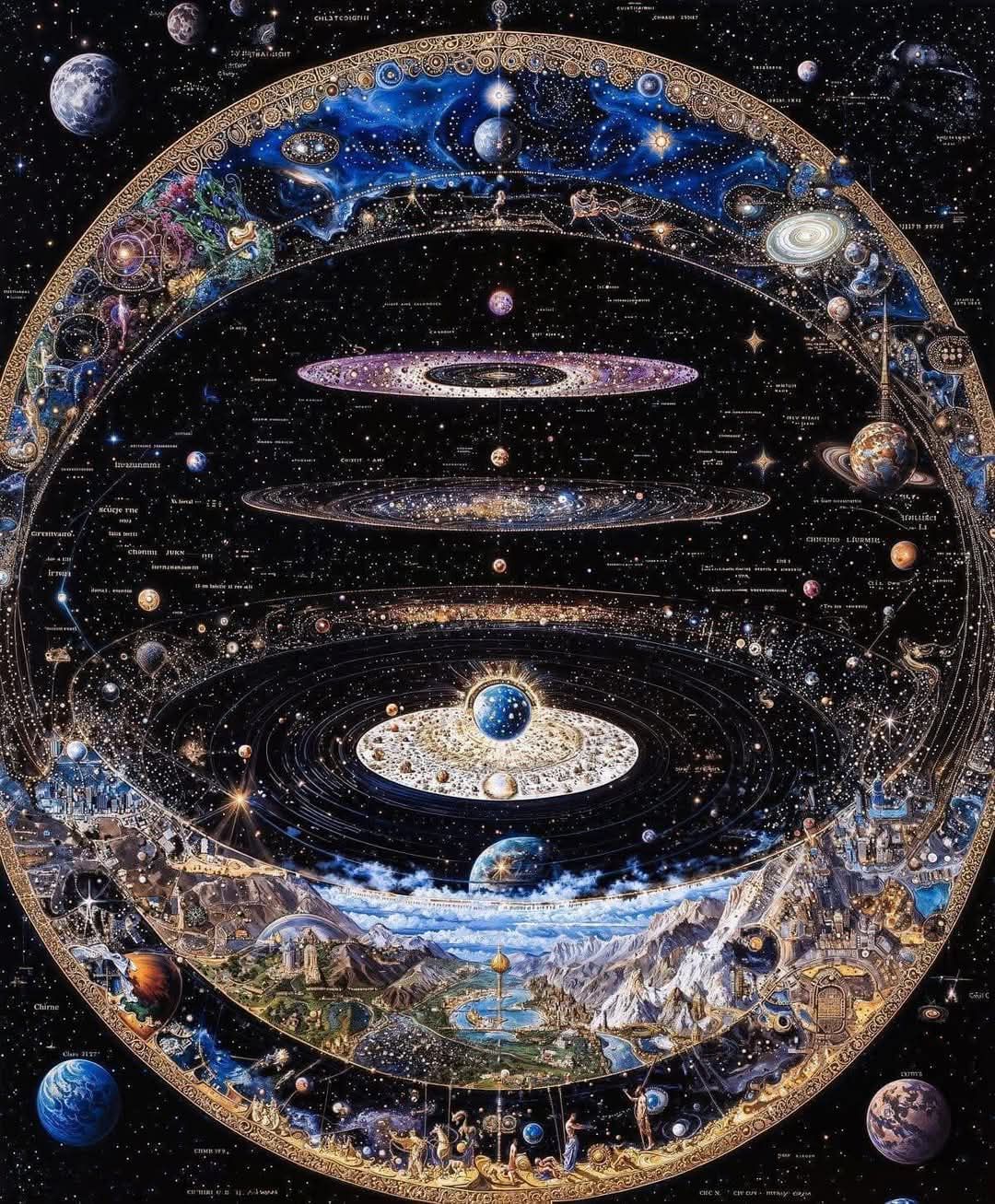
It is a profound echo of a biblical cosmology that has been systematically erased from our collective understanding—a truth so unsettling to the modern paradigm that it has been relegated to the fringes of thought, dismissed as myth or conspiracy. This image, with its concentric layers of celestial realms, its firmament shimmering like a crystalline dome, and its depiction of an enclosed earth at the center of creation, invites us to reconsider everything we’ve been taught about the universe. It beckons us to peer into a worldview that ancient cultures, including the Hebrews, held as sacred—a worldview that, if true, would unravel the very foundations of the materialist narrative we’ve been fed for centuries.
In the biblical account, the cosmos is not the chaotic, infinite expanse of modern astrophysics, with its billions of galaxies and light-years of emptiness. Instead, it is an ordered, intimate creation, described in Genesis 1:6-8 as a structured system where God separates the “waters above” from the “waters below” with a firmament—a solid, dome-like barrier. This firmament, often depicted as a crystalline expanse, holds back the celestial waters and serves as the foundation for the heavens above, where the sun, moon, and stars are set as “lights” to govern the day and night (Genesis 1:14-18). Beyond this dome, according to ancient texts like the Book of Enoch, lie the higher heavens—realms of divine beings, angelic hosts, and the very throne of God Himself. Job 37:18 speaks of the sky as “strong, and as a molten looking glass,” a description that aligns with this idea of a tangible, solid structure, not a boundless vacuum.
At the center of this cosmology lies the earth—not a spinning globe hurtling through space, but a flat, stationary plane, as described in Isaiah 40:22, where God “sits above the circle of the earth.” This earth is enclosed, surrounded by the “pillars of the earth” (Job 9:6) and bordered by the “ends of the earth” (Deuteronomy 28:64), with the Antarctic ice wall potentially serving as a physical boundary, a concept whispered about in ancient maps and modern accounts like those of Admiral Richard Byrd. Byrd, a 20th-century explorer, reportedly spoke of vast, uncharted lands beyond the South Pole—lands that defy the spherical model and hint at an enclosed system, though his findings were quickly classified by the U.S. government. This enclosed earth, in biblical cosmology, is the focal point of creation, a stage where humanity plays a central role under the watchful eye of a Creator who is near, not distant.
So why has this ancient understanding been buried? The answer lies in a centuries-long campaign to disconnect humanity from its divine origins. The shift began in the Renaissance with the rise of heliocentrism, championed by Copernicus, Galileo, and later Newton. Their model—a sun-centered universe with a spinning, spherical earth—overthrew the geocentric, biblical cosmology that had dominated for millennia. This wasn’t just a scientific revolution; it was a philosophical one, aligning with the rise of materialism and the Enlightenment’s rejection of the sacred. By the 20th century, Einstein’s relativity and the Big Bang theory cemented the modern narrative: a universe of random chance, where humanity is a cosmic accident on a tiny rock in an infinite void. This narrative strips away purpose, replacing it with nihilism, and makes humanity easier to control. A people who believe they are insignificant specks in a meaningless universe are less likely to question authority or seek a higher truth.
But what if the biblical model holds truths we’ve been conditioned to ignore? Ancient cultures across the globe—Sumerians, Egyptians, and even early Christians—shared similar cosmologies, describing an enclosed earth under a dome-like sky. The Book of Enoch, excluded from most modern Bibles, details a flat earth with portals for the sun and moon, and a firmament separating the earthly realm from the divine. Even modern anomalies support this view. NASA’s own research has detected water vapor in the upper atmosphere, echoing the “waters above” of Genesis, yet this is rarely discussed. Former NASA employees and whistleblowers have claimed the agency hides evidence of a barrier-like structure at extreme altitudes, a possible firmament. The Van Allen radiation belts, which make space travel beyond low Earth orbit nearly impossible, could be another clue—a natural boundary we weren’t meant to cross.
The artwork captures this suppressed vision with haunting detail: the firmament glows with ethereal light, celestial beings traverse the heavens, and the earth below is a vibrant, sacred space, not a random speck. It’s a reminder that in this cosmology, humanity is not an accident but the centerpiece of a divine plan, living in a universe designed with intention. The implications are staggering. If true, it means the stars are not distant suns but luminaries fixed in the firmament, as Genesis suggests. It means space travel, as we’ve been told, may be a fabrication—consider how all “space” footage comes from NASA, an agency with a history of questionable transparency. It means the Creator is closer than we’ve been led to believe, and our connection to the divine is more tangible than we’ve dared to imagine.
The powers that be—governments, scientific institutions, even some religious leaders—have a vested interest in keeping this truth hidden. An awakened humanity, rooted in the knowledge of its sacred place in a divine cosmos, would be impossible to manipulate. It would reject the fear-based systems that thrive on our perceived insignificance. It would demand answers about why we’ve been lied to, why ancient texts have been suppressed, and why explorers like Byrd were silenced. This artwork, with its intricate layers and cosmic harmony, is a call to question the narrative, to dig deeper into the mysteries of creation, and to reclaim a truth that has been stolen from us. What if the universe isn’t what we’ve been told? What if the biblical cosmology, dismissed as primitive, is the key to understanding our true place in the grand design? The choice to seek that truth is ours.
 Apostolic Pentecostal Network
You must be logged in to post a comment.