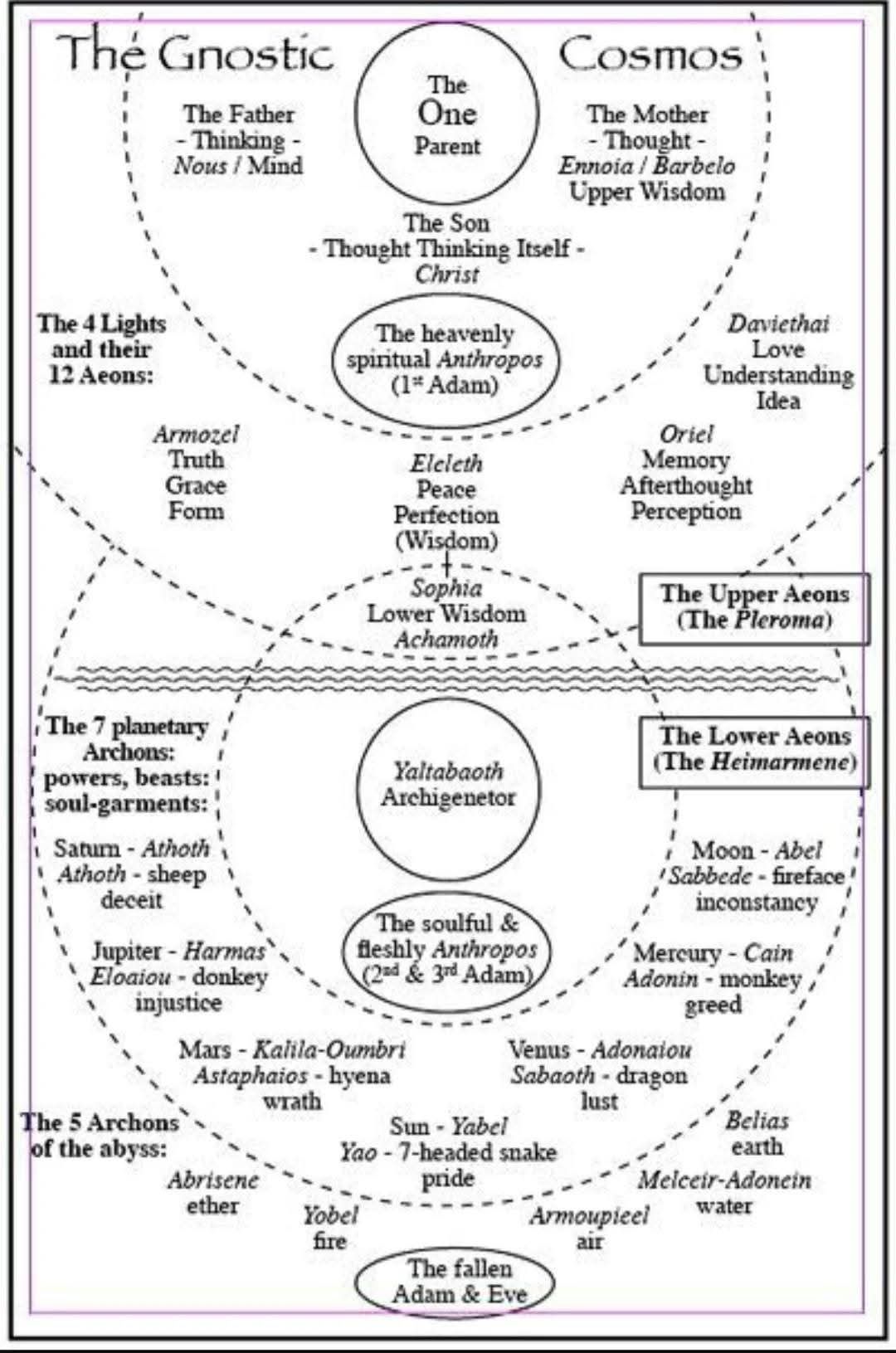
In Gnosticism, the term Great Archon describes the primordial being responsible for creating the world. This figure is noted for its beauty, strength, and wisdom. Archons are any number of world-governing powers that were created with the material world by a subordinate deity called the Demiurge (Creator).
In Theosophical terms, Pistis Sophia represents the soul, or more specifically, the part of the soul that incarnates; namely, the Monad of consciousness in the concrete mind. Her name is a key to her role: Pistis is the Greek word for faith. Not blind faith, but faith arising from total conviction of inner knowledge. Aeons is derived from the Greek Aion or age, are entities governing zones of existence, or planes of consciousness, between heaven and earth.
Sophia is Greek for wisdom. Thus her compound name indicates the fundamental principle that enables her to undertake her mission, namely, the development of wisdom in both worlds. Her consort is Jesus, the aspect of the soul that unfolds the triple-natured higher Self in line with Pistis Sophia’s progress in the material world. Jesus remained behind in the higher planes when she descended into chaos. This separation expresses the split in consciousness between the higher and lower nature of man.
Although man is really one with his divine Self, the usual level of his consciousness cannot reach the spiritual planes; thus in the myth Pistis Sophia and Jesus are presented as separate entities. The villain of the story is the Self-Centered One, standing for the ego, an appropriate name for the vain and egotistic “I,” which always demands to be the center of attention and strives for the gratification of the senses, thus causing great affliction for the soul.
The regents or archons of the Aeons are the main allies of the Self-Centered One, and they stand for the emotions and passions of man. Leading them is the Lion-Faced Power, an emanation of the Self-Centered One, standing for egotism, the strongest force driving man away from God and into chaos. While chaos, in the system of this text, is a region of the underworld, the term is mostly used to convey the image of a psychological state of disorder.
Since Pistis Sophia is the Monad of consciousness, when it is said that she falls into chaos, it means that she becomes prey to mental disorders resulting from emotions, desires, and passions. She becomes conditioned by names and forms, by cultural values and mores, by a whole gamut of conditions that represent a virtual prison to the incarnated soul, in short, the delusion of separateness. Thus Pistis Sophia’s descent into chaos is a symbolic description of man’s entrance into the cycle of incarnation, where he will remain until his mission is accomplished.
Archons is a Greek term used in Theosophical literature to denote primordial planetary spirits (the seven highest Hierarchies corresponding to the Christian Archangels). A term used in Gnosticism to describe a power subordinate to the Deity responsible for the creation of the world. The presiding official of the Greek Eleusinian Mysteries was called an Archon.
Most of the Western Christian Kabalists ― pre-eminently Eliphas Levi ― in their desire to reconcile the Occult Sciences with Church dogmas, did their best to make of the “Astral Light” only and preeminently the Pleroma of early Church Fathers, the abode of the Hosts of the Fallen Angels, of the Archons and Powers.
The Kings of Egypt often exercised the functions of the Priest-hood; and they were Initiated into the sacred science as soon as they attained the throne. So at Athens, the First Magistrate, or Archon-King, superintended the Mysteries. Under the Archonship of Euclid, bastards and slaves were excluded from Initiation; and the same exclusion obtained against the Materialists or Epicureans who denied Providence and consequently the utility of Initiation.
By a natural progress, it came at length to be considered that the gates of Elysium would open only for the Initiates, whose souls had been purified and regenerated in the sanctuaries. But it was never held, on the other hand, that Initiation alone sufficed. We learn from Plato, that it was also necessary for the soul to be purified from every stain: and that the purification necessary was such as gave virtue, truth, wisdom, strength, justice, and temperance.
That Saint Paul had been, partially at least, if not completely, initiated into the Theurgic mysteries, admits of little doubt. His language, the phraseology so peculiar to the Greek philosophers, certain expressions used but by the Initiates, are so many sure ear-marks to that supposition. Saint Paul, in speaking of the rulers of this world, the Cosmocratores, only said what was said by all the primitive Philosophers of the ten centuries before the Christian era, only he was scarcely understood, and was often wilfully misinterpreted.
Damascius repeats the teachings of the Pagan writers when he explains that:
“There are seven series of cosmocratores or cosmic forces, which are double: the higher ones commissioned to support and guide the superior world; the lower ones, the inferior world (our own).”
And he is but saying what the ancients taught. Iamblichus gives this dogma of the duality of all the planets and celestial bodies, of gods and daimōns (spirits). He also divides the Archontes into two classes — the more and the less spiritual; the latter more connected with and clothed with matter, as having a form, while the former are bodiless (Arupa).
The Zoroastrians regarded their Amshaspends as dual entities (Ferouers), applying this duality ― in esoteric philosophy, at any rate ― to all the spiritual and invisible denizens of the numberless worlds in space which are visible to our eye.
In a note of Damascius (sixth century) on the Chaldean oracles, we have a triple evidence of the universality of this doctrine, for he says:
“In these oracles the seven Cosmocratores of the world, (‘The World-Pillars,’) mentioned likewise by Saint Paul, are double ― one set being commissioned to rule the superior worlds the spiritual and the sidereal, and the other to guide and watch over the worlds of matter.”
Such is also the opinion of Jamblichus, who makes an evident distinction between the Archangels and the Archons. The above may be applied, of course, to the distinction made between the degrees or orders of spiritual beings, and it is in this sense that the Roman Catholic Church tries to interpret and teach the difference; for while the Archangels are in her teaching Divine and Holy, their doubles are denounced by her as devils. If enumerated, they will be found to be the Hindu “divisions” and choirs of Devas, and the Dhyani-Chohans of Esoteric Buddhism.
Archon means ruler; originally celestial beings, these primordial planetary spirits or Dhyani-Chohans transfer their mystic fluids or essences into their “shadows” or vehicles, thus enabling them to manifest on the various planes of the universe. In one sense, they are the Fallen Angels, counterparts alike of the highest celestial beings of the Hierarchies and of the human personalities at the lowest rung of the ladder of emanations.
Hence they are humanity’s teachers or Guardian Angels, made by theology into evil spirits, and contrasted with Archangels, their own supreme and primordial essences. These beings are concerned with a kind of hypostatic action or a transference of consciousness, vitality, and force from a higher to lower planes through various vehicles or sheaths in which the descending ray clothes itself on the different planes of the universe that it traverses.
Archon was also the Athenian name for the supreme authority established after the abolition of royalty in 1068 BC. After 683 BC nine were chosen by election or lot, each holding office for one year, one of whom, the Archon Basileus (ruler king), was the initiated and initiating Hierophant in the Mysteries of Eleusis. In accordance with all ancient Initiations the Initiator, whether supreme or secondary, was held to be an embodiment, at least temporarily, of spiritual-intellectual powers which worked for the time being through him.
Thus the Occultists are not alone in their beliefs. Nor are they so foolish, after all, in rejecting even the “gravity” of modern Science along with other physical laws, and in accepting instead attraction and repulsion. They see, moreover, in these two opposite Forces only the two aspects of the universal unit, called manifesting mind; in which aspects, Occultism, through its great Seers, perceives an innumerable Host of operative Beings: Cosmic Dhyan-Chohans, Entities, whose essence, in its dual nature, is the Cause of all terrestrial phenomena.
For that essence is co-substantial with the universal Electric Ocean, which is Life; and being dual, as said ― positive and negative ― it is the emanations of that duality that act now on earth under the name of “modes of motion”; even Force having now become objectionable as a word, for fear it should lead someone, even in thought, to separate it from matter! It is, as Occultism says, the dual effects of that dual essence, which have now been called centripetal and centrifugal forces, negative and positive poles, or polarity, heat and cold, light and darkness, etc., etc.
Once the illusion of separateness is overcome, the Initiate is entitled to enter nirvana. Thus, at this point, Jesus takes Pistis Sophia to a region just below the Thirteenth Aeon, her original station, probably a reference to the Fourth Initiation, which turns the seeker into an Arhat or enlightened one. This contrast can be removed only by the true knowledge of the supreme Self and not by the complicated logic or empty arguments. This specific sense is indicated by the words ‘this supreme truth can be known only by the realized one.’
“Man must overcome the seven planets and transmute them into soul powers. Their negative forces are the seven deadly sins, which are overcome by a symbolic struggle with demons and dragons and, in turn, are transmuted into seven cardinal virtues. This is the key to alchemy, for from the seven base metals, first spiritualized and brought together as a secret compound, is produced the philosophers stone, the purified soul.”
― Manly P. Hall – The Secret Teachings of All Ages
This mysterious Initiation, which is said to be conferred by the initiate upon himself, is the end of the soul’s pilgrimage. The man has learned all there is to be learned as a man, and embarks on another journey beyond the realm of humanity in the endless spiral of eternal evolution. The symbolic image of being elevated to the Height conveys the idea of a monumental expansion of consciousness to the adept, encompassing all planes from earth to heaven.
The human ego in its current models is a fragmented and internally conflicted operating system. This condition creates affective and cognitive deadlocks, repetitive self-sabotage, delusional projections, and stunted capacity to function as a responsible adult. Spiritual practice must focus on the integration and resolution of contradictory attitudes and drives. Once accomplished, your consciousness can expand to higher levels of intelligence and creative power that can blossom into total freedom and fulfillment.
You Don’t Know Your Real Potential.
 Apostolic Pentecostal Network
You must be logged in to post a comment.