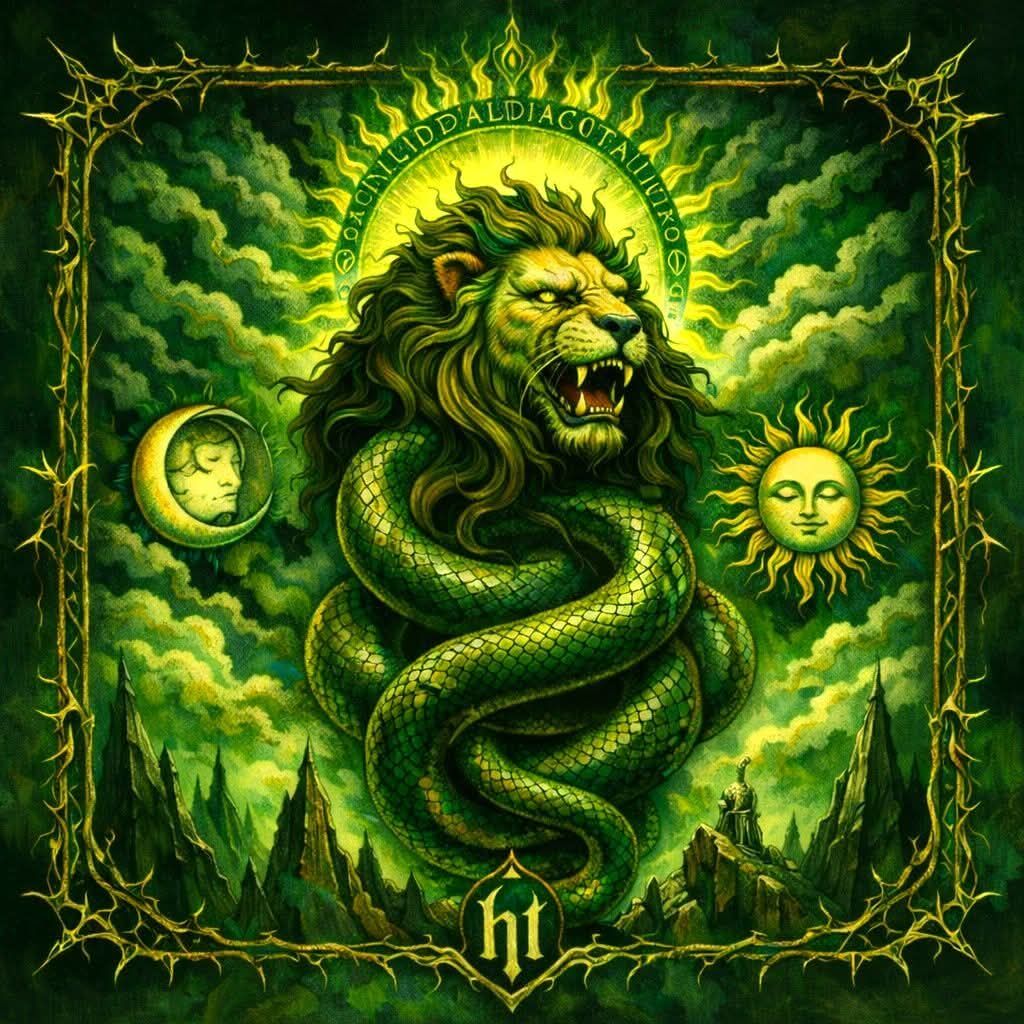
Is the God of the Old Testament the Demiurge? This is a question the early Church feared, suppressed, and branded as heresy, not because it was foolish, but because it was dangerous. Dangerous ideas are always buried, not refuted.
What if the god who creates the world in Genesis is not the highest God at all, but a lesser cosmic ruler? What if the jealous, wrathful, law giving deity of the Old Testament is not the Infinite Source, but a fragmented intelligence operating below the true Divine? This idea is not modern rebellion. It is ancient.
In Gnostic cosmology, the highest God is unknowable, invisible, and beyond form. This ultimate reality is called the Monad. It does not command, punish, or demand worship. It simply emanates being. From this divine fullness, known as the Pleroma, emerge spiritual intelligences called Aeons, expressions of divine qualities rather than rulers or tyrants.
Then comes the fracture. Sophia, divine wisdom, emanates without her counterpart, and from this imbalance arises a flawed creator. Ignorant of the higher realms and cut off from the Pleroma, this being fashions the material universe and proclaims, “I am God, and there is no other.” The Gnostics named him the Demiurge, also called Yaldabaoth. Not pure evil, but dangerously ignorant, a creator who does not know the Source from which he came.
Now read the Old Testament again, slowly and without fear. A god who walks in the garden, who feels regret, who becomes angry, jealous, and vengeful. A god who demands blood sacrifice and absolute obedience. A god who hardens hearts, commands genocide, and governs through fear, law, and punishment. This is not the language of infinite perfection. It is the language of limitation.
The Gnostics noticed something later theologians tried desperately to erase. The god of Moses behaves nothing like the God revealed by Jesus. One governs through commandments and punishment, the other teaches through parables and liberation. One binds humanity to external law, the other points inward and says, “The Kingdom of God is within you.”
Even the names reveal the fracture. YHWH appears in fire, thunder, prohibition, and separation. Christ appears in light, stillness, intimacy, and remembrance. The Old Testament god says, “Obey and live.” Jesus says, “Know and be free.”
This pattern is not unique to Gnosticism. In ancient Mesopotamia, lesser gods known as the Anunnaki governed the material world beneath higher unseen principles. In Platonic philosophy, the perfect realm of Forms exists above the imperfect material copy. In Hindu tradition, Brahman is the ultimate, formless reality, while Brahma the creator operates within time, illusion, and limitation.
In Egyptian cosmology, Ptah conceives reality through divine mind, while lesser gods administer form and structure. In Zoroastrianism, the material world is shaped by opposing cosmic forces rather than a single benevolent will. Across cultures, the same distinction appears: the Absolute above, the craftsman below.
Even Jewish mysticism quietly agrees. The Kabbalah speaks of Ein Sof, the infinite and unknowable source beyond all attributes. Below it flow emanations that shape structure, law, and manifestation. When imbalance occurs, shells form, trapping divine light within material existence. This is uncomfortably close to Gnostic cosmology to be ignored.
Then comes the greatest scandal of all, the serpent in Eden. In orthodox theology, the serpent is deception and evil. In Gnostic interpretation, the serpent is illumination. The god forbids the Tree of Knowledge, while the serpent encourages awareness. One demands obedience, the other initiates awakening. Ask yourself honestly who benefits from ignorance.
The Demiurge is not a cartoon villain. He is cosmic ego, mistaking authority for ultimacy, law for truth, and control for order. Humanity, carrying a divine spark from beyond his realm, becomes trapped in a system of fear, guilt, worship, and submission.
This is why Gnosticism was exterminated. If the Old Testament god is not the highest God, religious authority collapses. If salvation comes through knowledge rather than obedience, priesthood loses its power. If the kingdom is within, temples, intermediaries, and control systems become irrelevant.
The Gnostics were not denying God. They were redefining Him. The true God does not threaten hell, demand sacrifice, or rule through fear. The true God awakens remembrance.
This is not an attack on scripture. It is an initiation into reading it esoterically. Ancient texts were never meant to be read literally. The violence is psychological, the wars are internal, and the jealous god is the ego enthroned as deity.
Perhaps the most dangerous idea of all is this: the god who says, “You shall have no other gods before me,” may be revealing insecurity, not supremacy. And perhaps Christ did not come to appease that god, but to reveal the Father beyond him.
Read slowly. Question deeply. Fear nothing. Truth has always been forbidden.
 Apostolic Pentecostal Network
You must be logged in to post a comment.