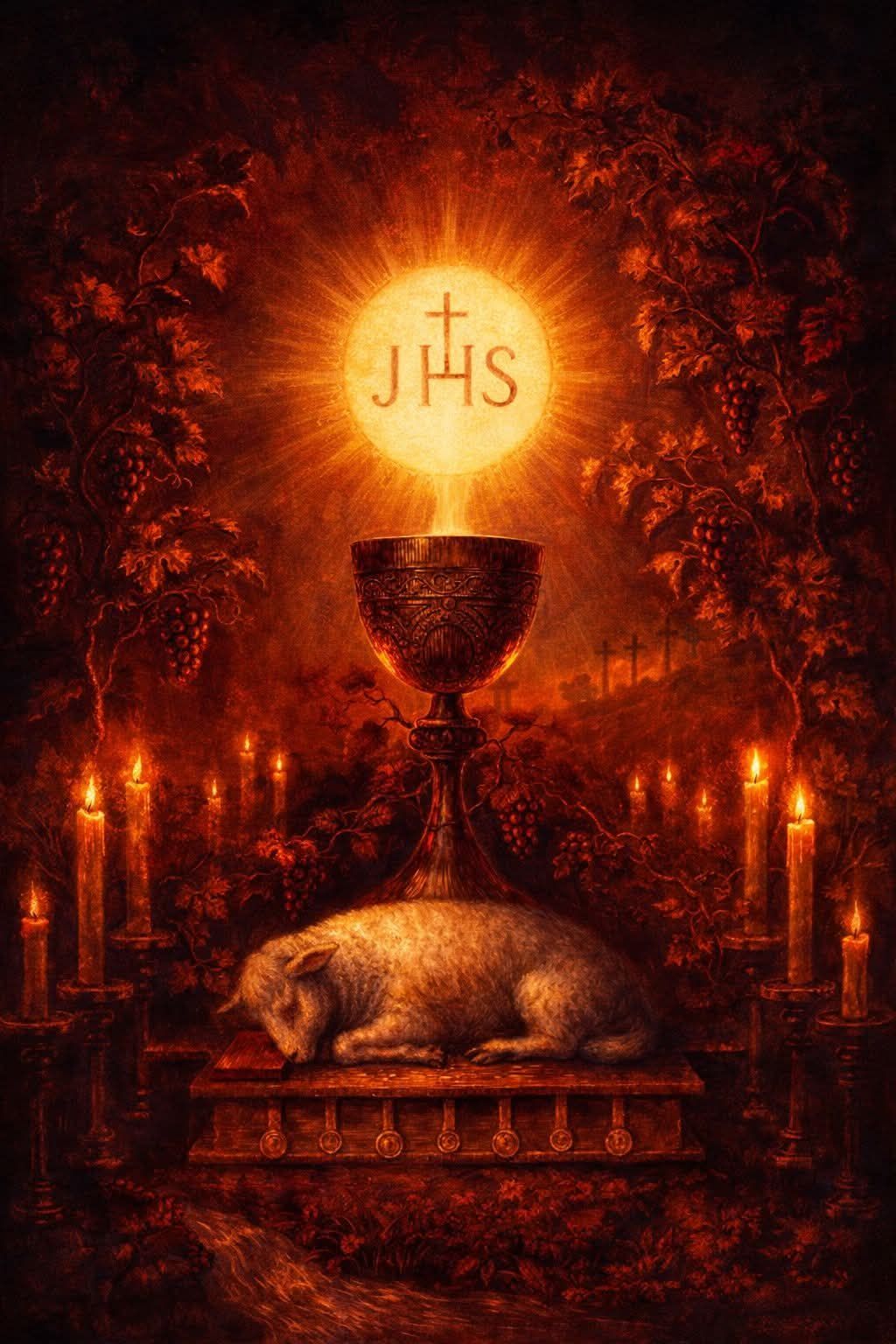
What if the Holy Communion was never meant to be understood literally, but ritually? Beyond church pews and polished chalices lies a mystery far older than Christianity itself. Bread and wine, body and blood, eating the god to become like the god. This is not a new idea. It is one of the oldest ritual formulas known to humanity.
In orthodox Christianity, Holy Communion is framed as remembrance. “Do this in memory of me.” Yet memory in ancient mystical language does not mean recollection. It means re-membering, the act of putting divine fragments back together within the human vessel. The ritual is not symbolic only. It is participatory. The initiate does not observe Christ, the initiate ingests Christ.
Long before the Last Supper, ancient Egypt practiced the ritual consumption of divine essence. Osiris, the dying and resurrecting god, was ritually eaten in the form of sacred bread so the people could absorb his regenerative power. In the Eleusinian Mysteries of Greece, initiates consumed a sacred drink, the kykeon, after ritual fasting and purification, entering altered states where immortality was not preached but experienced.
The wine as blood is even more controversial. In Dionysian rites, wine was literally understood as the blood of the god. To drink it was to invite divine madness, ecstasy, possession. Christianity stripped the frenzy but kept the formula. The same substance, now domesticated. The same ritual, now moralized. Different tone, identical architecture.
Mystically, communion mirrors alchemical transmutation. Bread represents the fixed matter, the body, the salt. Wine represents spirit, sulfur, life force. When consumed together, they enact the sacred marriage within the human being. Flesh and spirit united. The goal is not forgiveness alone, but transformation. “Christ in you” was never meant poetically. It was meant operatively.
Occult traditions understand ritual eating as sympathetic magic. You become what you consume. Shamans eat sacred plants. Totemic tribes eat animal flesh to absorb its strength. In tantra, sexual fluids are ritually exchanged for the same reason. Communion fits perfectly into this magical worldview, yet modern theology denies its power while still practicing it.
Here lies the difference between the exoteric and esoteric church. Exoterically, communion cleanses sin. Esoterically, it awakens divine memory encoded in the body. One teaches obedience. The other teaches embodiment. One requires belief. The other requires initiation.
The controversy deepens when we remember that early Christians were accused of cannibalism. Roman critics were not entirely wrong. The ritual was not metaphorical to its earliest practitioners. It was mystical realism. The god must die. The god must be eaten. The god must rise again inside the community.
So the question remains uncomfortable. Is Holy Communion merely symbolic bread and wine? Or is it a surviving fragment of an ancient god-eating rite, carefully sanitized for mass consumption? If the ritual truly had no power, why has it been preserved so carefully for two thousand years?
Perhaps the real sacrilege is not questioning communion, but taking it without understanding what is being activated within you.
 Apostolic Pentecostal Network
You must be logged in to post a comment.