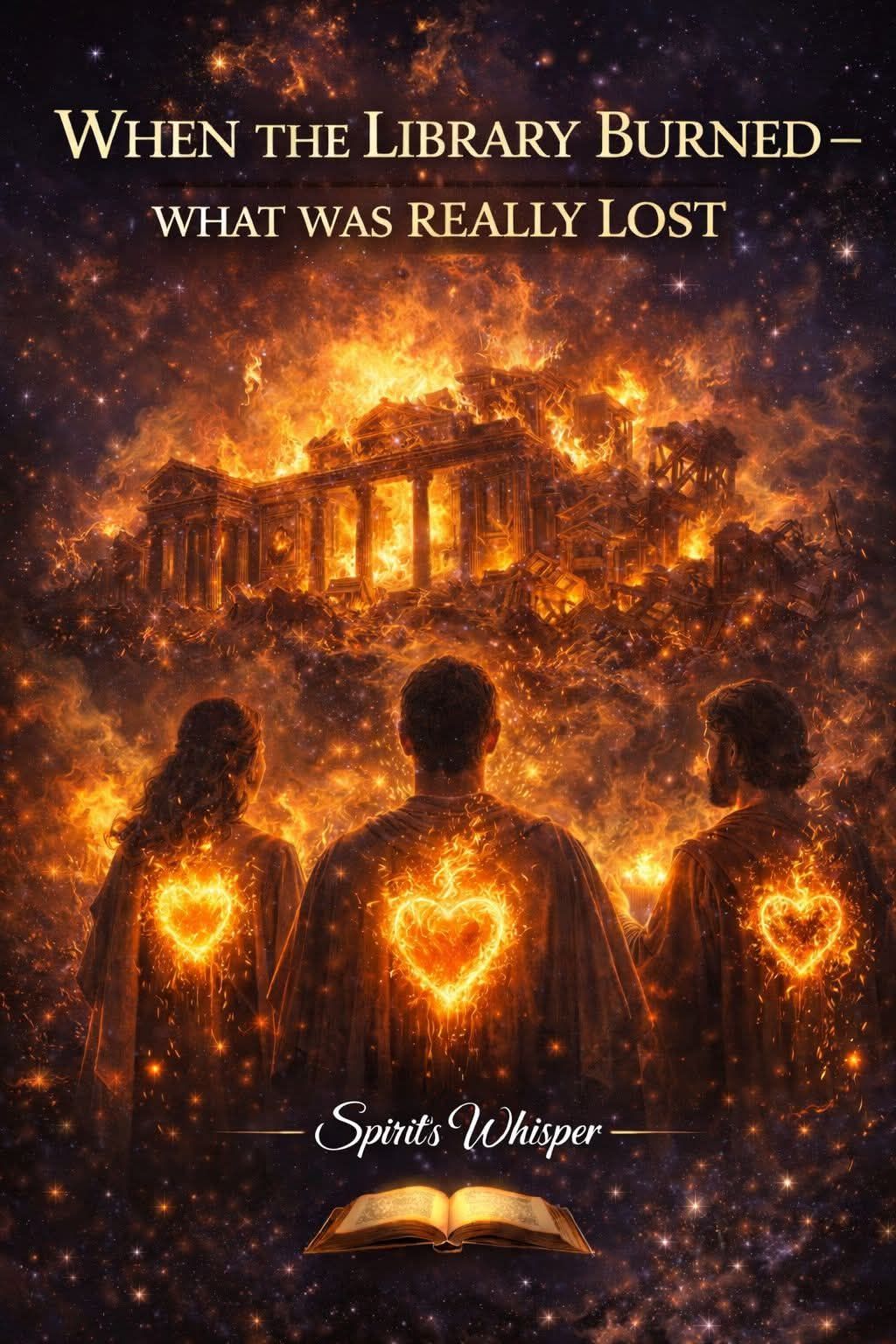
WHEN THE LIBRARY BURNED — WHAT WAS REALLY LOST
When Helena Blavatsky wrote about the destruction of the Library of Alexandria, she was not merely mourning the loss of books. She was pointing to the loss of memory.
Alexandria was not simply a warehouse of scrolls. It was a convergence point. A place where Egyptian, Greek, Jewish, Persian, Indian, and early Christian wisdom sat side by side. Myth, astronomy, mathematics, medicine, mysticism, and theology were not separated into competing silos. They were understood as different lenses looking at the same underlying reality.
What threatened emerging dogma was not information, but synthesis.
When religion requires control, unity of experience becomes dangerous. If people discover that truth can be encountered directly — across cultures, symbols, and practices — authority shifts inward. The need for a single approved interpreter collapses.
This is why mysticism is always the first thing to be labeled heresy.
The Adepts Blavatsky referenced were not secret magicians hoarding power. They were initiates of inner knowledge — those who understood that revelation is not confined to one nation, one book, or one era. They taught that all religions point back to the same source, because consciousness itself is the source.
Dogma cannot survive that realization.
So instead of teaching how to encounter truth, systems began teaching what to believe about it. Instead of initiation, we received instruction. Instead of union, we received compliance. Instead of wisdom, we received permission structures.
And yet, the irony remains.
Even after libraries burn, truth does not disappear.
It relocates.
It moves from stone to story.
From scroll to symbol.
From temple to heart.
This is why mystics keep reappearing across history — in every tradition — saying the same thing in different languages:
The Kingdom is within.
The Logos is alive.
The veil is perceptual, not cosmic.
The burning of Alexandria did not end the ancient stream.
It only forced it underground — where it has always flowed best.
Truth was never fragile.
It cannot be burned, buried, or erased.
What was hidden was not knowledge — but access.
And access was never taken away.
It was simply forgotten.
 Grace Watcher Network
You must be logged in to post a comment.