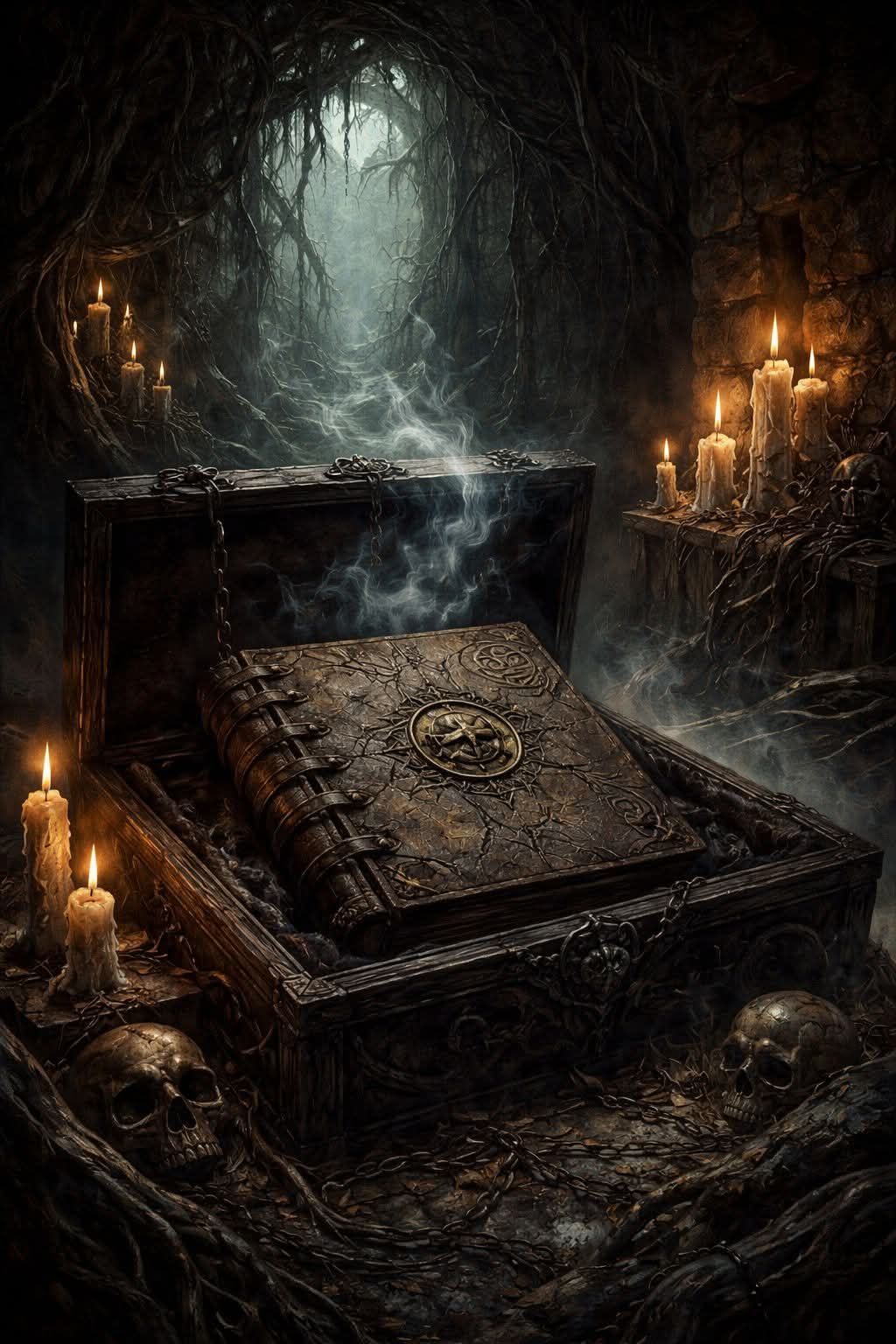
Beneath the old layers of the forest, where trees bend their thorns down as keepers of secrets, stands an edifice that defies the memory of the living. Their walls, covered in lichens dripping shadow, look like held breaths. It is not a shelter for humans: it is a forgotten sanctuary of that which should never be awakened. The wind drags murmurs of extinct eras, and among them echoes of cities that Yss-Korath would have condemned to oblivion.
Inside, under beams that crumble like stone complaints, lies a chest black The wood seems to drink the penumbra itself; the locks crack with a metallic lament. When you open it, no light emerges: just an expecting emptiness that awaits the daring.
There rests the book. His leather, worn for centuries that can never be measured, is a fragment of a dark, fragmentary time, where past and future intertwine like tentacles of a god who never had a name. The pages feel alive; as you scratch them, a cold breath permeates the marrow and whispers secrets only madness could record.
The language is strange and familiar at the same time. Words that Lui Lemerchant would have written in feverish delirium are intertwined with graphs that seem to pulse, twisting over themselves as if Lovecraft had blown its breath onto them. On the margins, signs no philologist can identify draw forgotten deities rituals, offerings that were never accepted, and power routes that traverse time and sanity.
When you open the first page, one does not read: one is read. Sentences are like fragments of stolen memory, visions of worlds where flesh and shadow merge, and where light is a luxury no one remembers.
There are no instructions. There are no warnings. Just one sentence repeated, three times on different pages, like a whisper that cuts across eras and dimensions:
“Don’t open if you’re looking for answers.
What you observe is older than oblivion.
Only madness will survive reading. ”
The air around the chest is dense. A visitor feels that every shadow breathes around him; that the very trees of the forest murmur in a language that only the condemned and chosen could understand.
In the end, the book is not an object. It is a portal, a fragment of a universe that remembers and anticipates, a rift in reality from which the ancients still whisper and conspire.
And while the chest rests, still closed, one understands that the curious who seek it will not find a common grimory: they will find a mirror that reflects their own madness.
 Apostolic Pentecostal Network
You must be logged in to post a comment.