Most people try to “think” their way into peace.
But your nervous system doesn’t follow your thoughts first… it follows your state.
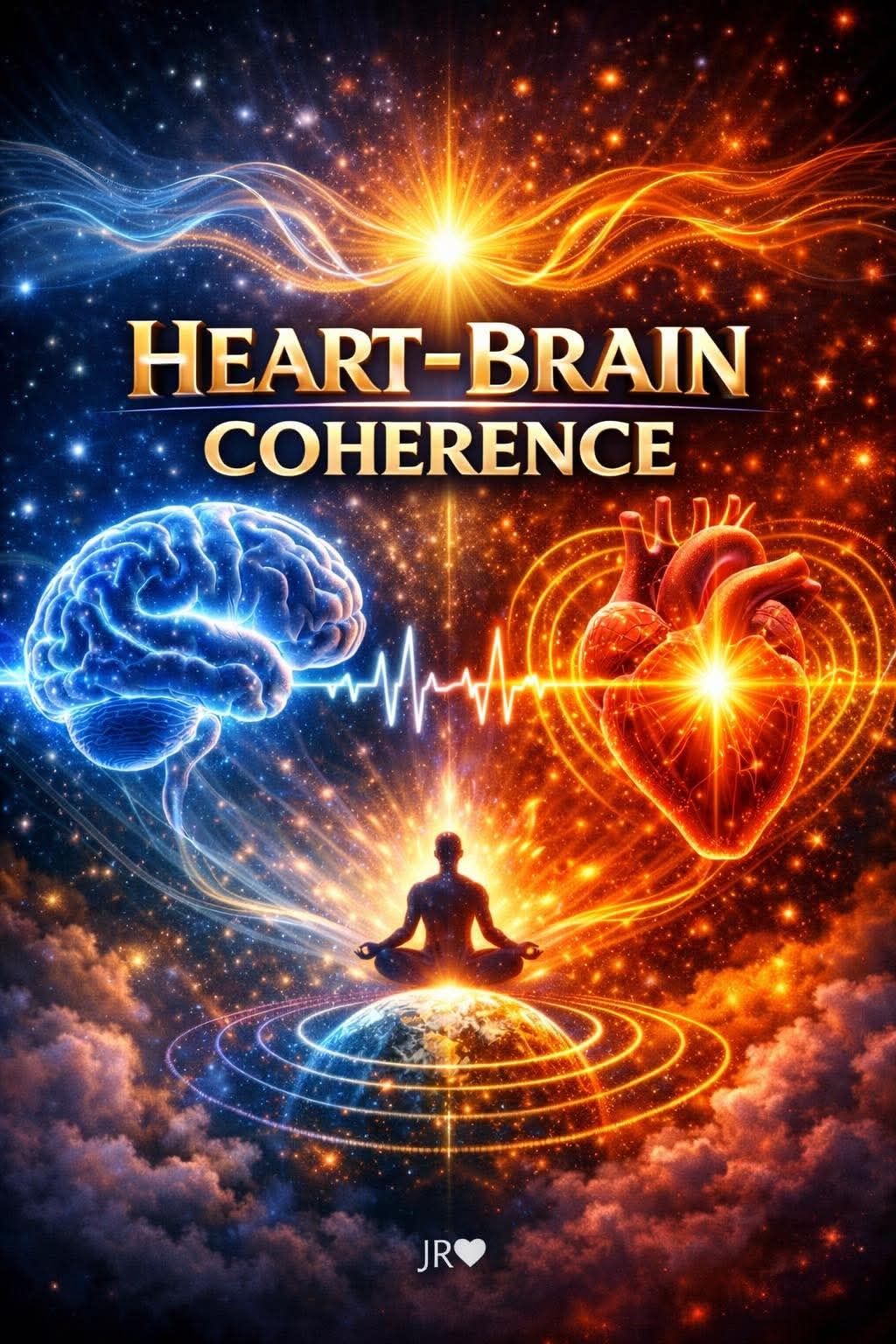
Heart–brain coherence is a measurable state where your heart rhythm becomes smooth and ordered — and your brain, hormones, and nervous system start syncing to that signal.
That’s the moment you go from inner conflict to inner harmony.
🧠 What modern science points to
• The heart has its own intrinsic neural network (often called the “heart brain”).
• The heart sends powerful rhythmic information upward to the brain — influencing attention, mood, and stress response.
• When you sustain emotions like gratitude, compassion, appreciation, calm focus, your heart rhythm becomes coherent (smooth + stable).
And coherence tends to show up as:
• clearer thinking
• steadier emotions
• stronger stress resilience
• better decision-making
• less “mental noise”
When you’re in fear, anger, or anxiety, heart rhythms become chaotic — and the brain reads that as: “Something is wrong.”
So even if you want clarity… your biology keeps broadcasting threat.
❤️ The heart isn’t just a pump
Your heart is also an electromagnetic organ — and its field is one of the strongest measurable fields in the body.
In simple terms:
Coherence means your biology stops sending mixed signals.
One message. One rhythm. One inner order.
🜂 Ancient teachings said this first (different language… same truth)
• Egypt: the heart (Ib) as the seat of conscience and truth, weighed against Ma’at (cosmic order).
• Taoism: harmony of heart-spirit and mind supports vitality and longevity.
• Hermeticism: “As within, so without” — inner order creates outer order.
• Vedic wisdom: heart-centered awareness dissolves fragmentation.
They weren’t teaching suppression.
They were teaching alignment.
🌿 The real psychological shift
Coherence isn’t “controlling emotions.”
It’s integrating them — so your system stops fighting itself.
You don’t overpower the mind.
You entrain it through the heart.
🧘 How to enter heart–brain coherence (2–3 minutes)
1. Breathe slow and even: 4–6 seconds in, 4–6 out
2. Bring attention to the center of the chest
3. Evoke a real feeling: gratitude / appreciation / calm
4. Hold it gently for 2–3 minutes
That’s it.
Your nervous system recalibrates… and thought follows.
 Apostolic Pentecostal Network
You must be logged in to post a comment.