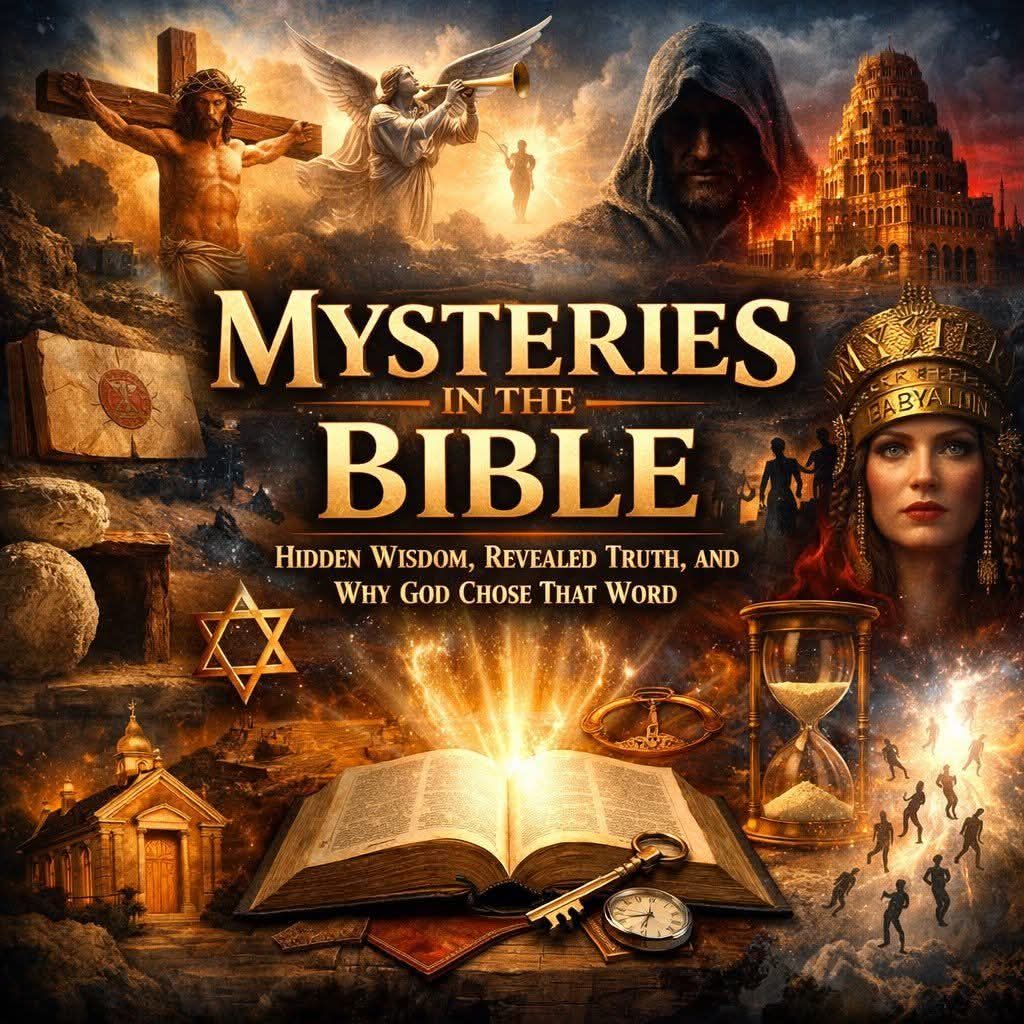
The Bible does not use words casually, and it certainly does not use the word “mystery” the way modern religion uses it. In a churchy mouth, “mystery” means fog, contradiction, or some holy shrug where nobody is allowed to ask questions. In the Bible, a mystery is not an excuse to stop thinking – it is God’s way of telling you that something was hidden on purpose, guarded on purpose, timed on purpose, and then revealed on purpose. That is why Jesus could say, “Because it is given unto you to know the mysteries of the kingdom of heaven, but to them it is not given” (Matthew 13:11). God is not stuttering there. He is dividing people by what they are permitted to understand.
Now someone will jump up and say, “But the Holy Spirit guides into all truth.” Amen – and that is exactly why this word matters. The Holy Spirit does guide a believer, but He guides through what God has revealed, not around it, and not beyond it. Jesus said, “Howbeit when he, the Spirit of truth, is come, he will guide you into all truth” (John 16:13). He did not promise private revelations that contradict Scripture, and He did not promise that every truth would be openly broadcast to every man in every age the same way. God has always operated with revelation and concealment. “The secret things belong unto the LORD our God: but those things which are revealed belong unto us” (Deuteronomy 29:29). That is not a devotional slogan. That is God’s operating procedure.
So when you see “mystery” and “mysteries” in the Bible, you are looking at a divine marker. You are looking at God’s vocabulary for hidden truth that becomes unveiled at the right time, to the right people, for the right reasons. The patterns around this word expose why so many Bible readers stay confused, why dispensationalism is not optional if you want the Bible to make sense, and why the end times are filled with deception. God’s mysteries are not there to entertain you. They are there to locate you in God’s timeline and to protect you from Satan’s counter timeline.
1. Why God Picked the Word “Mystery”
The first pattern is that “mystery” in Scripture is a word of timing, not a word of uncertainty. Paul says God is able to stablish you “according to my gospel, and the preaching of Jesus Christ, according to the revelation of the mystery, which was kept secret since the world began” (Romans 16:25). That one verse crushes the modern misuse of the term. The mystery was not unknowable. It was knowable, but it was kept secret. It was truth with a lid on it.
The second pattern is that God uses “mystery” to train you to stop reading the Bible like a pile of inspirational quotes and start reading it like a book with stages. Proverbs tells you, “It is the glory of God to conceal a thing: but the honour of kings is to search out a matter” (Proverbs 25:2). God gets glory out of concealment, and the believer gets honor out of diligent searching. That is why “mystery” is a teaching word. It forces you to admit God did not reveal everything to everybody at the same time, and that admission is the first step toward Bible sanity.
The third pattern is that the word “mystery” is God’s stamp of authority against man-made tradition. Religious systems love to keep people dependent on priests, gurus, scholars, and councils. The Bible says God reveals, and He reveals when He chooses, and He reveals to those who will receive it. Paul says God speaks “the wisdom of God in a mystery, even the hidden wisdom, which God ordained before the world unto our glory” (1 Corinthians 2:7). God had an ordained plan, and a timed unveiling, and it was not submitted for committee approval.
2. Mysteries and the Judgment of Light
The next pattern is that mysteries are tied to accountability. When Jesus speaks of mysteries, He immediately connects them to who gets light and who does not. He says, “Unto you it is given to know the mysteries of the kingdom of heaven, but to them it is not given” (Matthew 13:11), and in another place, “Unto you it is given to know the mysteries of the kingdom of God: but to others in parables; that seeing they might not see, and hearing they might not understand” (Luke 8:10). That is not God being unfair. That is God responding to men who do not want the truth.
Here is the hard part that many people miss. God does not merely reveal truth. He also judges men by truth. Light received becomes more light. Light rejected becomes darkness. Jesus said, “For whosoever hath, to him shall be given, and he shall have more abundance: but whosoever hath not, from him shall be taken away even that he hath” (Matthew 13:12). When a man insists on staying carnal, proud, and self-sufficient, God will let him keep his religion and lose his understanding.
This explains why “mystery” is not the opposite of the Holy Spirit. It is one of the ways the Holy Spirit operates. The Spirit of God is not in the business of flattering the flesh. He illuminates the Word to the submissive believer, and He leaves the rebel with his parables, his slogans, and his little emotional experiences. “If any man will do his will, he shall know of the doctrine” (John 7:17). The knowing is attached to the willing, and the mystery reveals who is willing.
3. Mysteries and Dispensational Boundaries
Another pattern is that “mystery” language appears where dispensational boundaries matter. In Ephesians, Paul says, “How that by revelation he made known unto me the mystery” (Ephesians 3:3), and then he explains that this was “not made known unto the sons of men, as it is now revealed unto his holy apostles and prophets by the Spirit” (Ephesians 3:5). That is dispensational truth stated plainly. Something “now” revealed was “not” revealed the same way before. That is not a preacher’s opinion. That is the Bible telling you the unveiling changed.
This is why people who hate dispensationalism always end up either confused or dishonest. They will quote John 16:13 about the Spirit guiding into truth, but they will pretend the Spirit guides everybody in every age into identical revelation. The Bible says otherwise. The Spirit can guide into all truth for the believer in this age while God still retains the right to reveal certain truths at certain times in the unfolding of His plan. “Surely the Lord GOD will do nothing, but he revealeth his secret unto his servants the prophets” (Amos 3:7). God reveals, but He reveals in order, and that order matters.
So the point of mysteries is not to build a chart obsession. The point is to honor God’s structure and stop forcing every verse into one flat system. When Paul calls himself a steward, he says, “Let a man so account of us, as of the ministers of Christ, and stewards of the mysteries of God” (1 Corinthians 4:1). A steward manages what belongs to another. That means God entrusted certain revelations to certain men at certain stages, and the Church is expected to receive them, not rewrite them.
4. Why Some Things Had to Be Hidden
There is a reason God hid some things, and it is not because He is playing games. The Bible reveals that there is a spiritual war in the unseen realm, and concealment is one of God’s weapons. Paul says the hidden wisdom was “ordained before the world unto our glory” (1 Corinthians 2:7), and then he shows that the princes of this world did not understand it. If you watch the Cross carefully through Scripture, you learn something sobering – Satan did not grasp the full trap God was setting.
God hid truth to protect the plan of redemption until the exact moment it could not be stopped. Jesus said, “No man taketh it from me, but I lay it down of myself” (John 10:18). That means no devil, no council, no empire was running the schedule. God ran the schedule. The mystery language tells you God was not reacting. He was executing.
There is also a moral reason God hides things. Hidden truth exposes motives. Some people want God. Some people want the benefits of religion. Some people want a spiritual hobby that never crosses their pride. When truth is wrapped in a “mystery,” the seeker digs and the sluggard shrugs. The hungry man searches and the proud man mocks. That is why Jesus could speak in parables. The parables were mercy to the humble and judgment to the hard.
5. Mysteries and the Limits of Human Reason
Another pattern is that “mystery” confronts the arrogance of human reason without endorsing irrationality. Men love two extremes. One extreme is rationalism that refuses anything it cannot measure. The other extreme is mysticism that refuses to define anything clearly. The Bible destroys both. It says truth is real and knowable, but it must be received on God’s terms.
Look at “the mystery of godliness.” “And without controversy great is the mystery of godliness: God was manifest in the flesh” (1 Timothy 3:16). That is a mystery because no human philosophy would ever invent it, but it is not a mystery because it is unclear. The verse states it. It defines it. It plants a flag. It tells you the incarnation is a revealed fact.
This is where the Holy Spirit guiding into truth comes back into view. The Spirit does not guide you into a truth God has refused to reveal. He guides you into the truth God has revealed, and He guides you away from the carnal habit of demanding that everything be reduced to something your mind can dominate. “Trust in the LORD with all thine heart; and lean not unto thine own understanding” (Proverbs 3:5). Mystery language trains the believer to be confident in revelation while staying humble about creature limits.
When people say, “The Bible is full of mysteries, so we cannot know doctrine,” they are using mystery as a mask for laziness or unbelief. Paul rebukes that with stewardship language. A steward is accountable. A steward does not say, “I was confused, so I ignored the inventory.” The presence of mysteries does not excuse ignorance. It condemns it when the mystery has been revealed.
6. Mysteries and the Two Hidden Kingdoms
One of the strongest patterns is that the Bible presents two competing hidden systems. God has mysteries that reveal Christ, the gospel, and His plan. Satan has mysteries that conceal iniquity and prepare his counterfeit kingdom. Paul says, “For the mystery of iniquity doth already work” (2 Thessalonians 2:7). That is not future tense. That is present. That means there is an underground spiritual engine pushing history toward a final manifestation.
Then Revelation shows you the public face of that hidden engine. “And upon her forehead was a name written, MYSTERY, BABYLON THE GREAT” (Revelation 17:5). Satan’s kingdom does not come in a red suit with a pitchfork. It comes with religion, with glamour, with unity talk, with spiritual language, with moral posturing, and with a hatred for the pure gospel. The word “mystery” appears on the forehead because the system thrives on concealed identity. It sells holiness while hiding fornication.
Here is the pattern many miss. God uses mystery language to reveal. Satan uses mystery language to disguise. God’s mysteries end with clarity. Satan’s mysteries end with confusion. That is why a believer who does not study “mystery” vocabulary is vulnerable. He will confuse spiritual atmosphere for the Holy Spirit. He will confuse unity for truth. He will confuse charisma for doctrine. He will confuse “deep” for “right.”
7. What Mysteries Produce in the Bible Believer
When you take the whole pattern, mysteries do three things in a Bible believer. First, they produce reverence for God’s timing. You stop acting like you are smarter than the Book. You stop demanding that every passage must be flattened into one simplified system. You learn to say what the verse says when it says it. “Study to shew thyself approved unto God” (2 Timothy 2:15). Approved means God is pleased with how you handle His words.
Second, mysteries produce discernment. You learn how God hides truth and how Satan hides evil. You learn that some things are concealed for mercy and others are concealed for deception. You learn that parables can be both a gift and a judgment. You learn that the Spirit guides you into truth, but He does it through Scripture, not around it, and not through emotional hunches that contradict the plain text.
Third, mysteries produce stability when everything gets noisy. When the world is shouting propaganda and the religious world is shouting unity, a believer grounded in Bible mysteries recognizes the old pattern. The mystery of iniquity is working. The mystery of God is unfolding. The end is not chaos. The end is a schedule. God said the mystery would be finished. “But in the days of the voice of the seventh angel, when he shall begin to sound, the mystery of God should be finished” (Revelation 10:7). That means the lid comes off. That means the masks come off. That means the war that was invisible becomes visible.
Conclusion
The word “mystery” is one of God’s most precise tools in the Bible because it does not allow casual reading. It forces you to face the fact that God has stages, administrations, revelations, concealments, judgments, and unveilings. It corrects the sloppy idea that the Spirit’s guidance means every man automatically understands everything the same way in every age. It teaches you that the Spirit guides you into the truth God has revealed, and that part of God’s revealed truth is that He once hid things and later unveiled them.
Mysteries also expose the heart. The humble man receives more light. The proud man loses what he thinks he has. Jesus did not speak mysteries and parables because He enjoyed riddles. He spoke them because men were already rejecting light, and God will not cast pearls before swine. At the same time, God will always feed the hungry. The seeker will find. The knock will be answered. The diligent will be rewarded. The Bible is not written to impress scholars. It is written to convert sinners and mature saints.
Finally, mysteries are not just theological curiosities. They are war terms. God’s mysteries unveil Christ. Satan’s mysteries conceal iniquity. One ends in the glory of God manifested. The other ends in judgment. If a believer wants to be stable in the last days, he must learn how God speaks, why God hides, when God reveals, and how Satan imitates revelation while pushing darkness. That is why the word matters. God chose it because it names the strategy. It marks the timeline. It separates the hearers. And it leads the Bible believer out of confusion and into clarity, where the Book is no longer a fog, but a lamp. “Thy word is a lamp unto my feet, and a light unto my path” (Psalm 119:105).
 Apostolic Pentecostal Network
You must be logged in to post a comment.