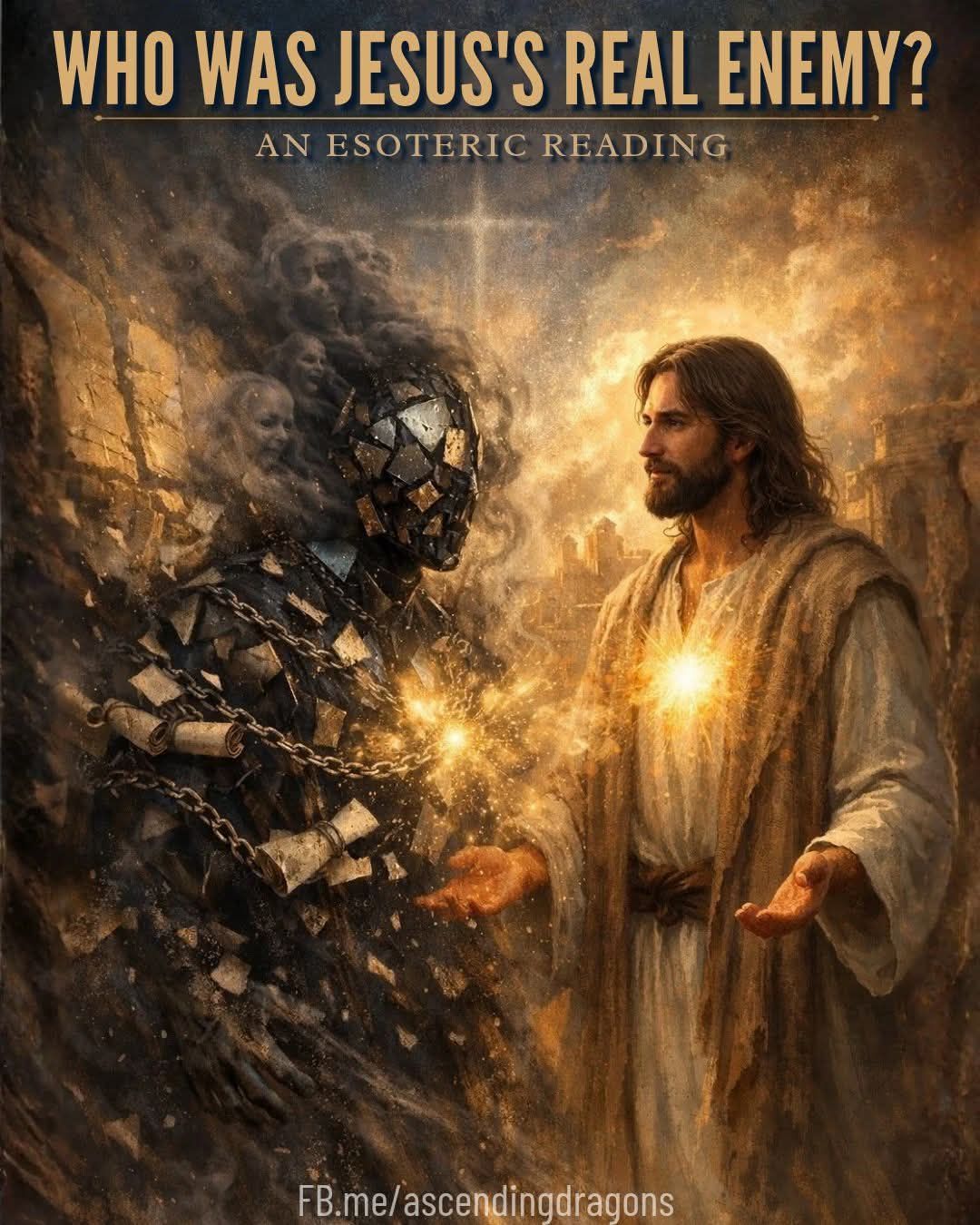
For those of you who have left Evangelical Christianity — the mental and intellectual prison that modern-day Christianity can become outside of academic spaces — this is going to resonate.
Who was Jesus’s real enemy?
Evangelical Christianity would say the devil. The Pharisees. Sin. Evil.
But in practice, when Jesus was actually teaching and preaching, what was the enemy he dealt with face to face?
It is unsophisticated to think it was a group of people.
—
Not The Pharisees?
—
I’ve been studying the Gospel of Thomas, and Jesus’s tension with the Pharisees bleeds into that tradition as well. And when you understand the true enemy, you begin to see an incredible global coherence of spiritual wisdom across traditions.
The unveiling is simple — and unsettling.
The biggest criticism Jesus gave was toward those who chose the riches of this world, the delusion of sensory intoxication, over the inward journey toward God. The awakening of the heart. The coherence between mind and heart.
The Pharisees become symbolic here. Disciplined in every letter of the law, yet lacking inward transformation — which is exactly what Jesus criticized.
—
The enemy was attachment
—
The enemy was attachment.
The enemy was ego.
The same enemy the Buddha spoke about.
Attachment to tradition. Ritual. Law. Identity. Culture. Schedule. Certainty.
They could not see outside themselves because attachment narrows perception.
Sin — missing the mark — becomes the result of attachment, aversion, and ego consciousness.
This coherence across faith traditions is striking. My guru, Yogananda, emphasized repeatedly the distractibility and vexation of the senses, and the necessity of meditation, contemplative prayer, chanting, and the renunciation of excessive worldliness to move from earth-based consciousness into Kingdom consciousness — heart-based consciousness.
“Sin” is a broad term.
Attachment and ego are precise.
They describe the relationship between a person and their experience.
In Thomas, Jesus says humanity is drunk — and that they will eventually wake up. Ego consciousness functions exactly like intoxication: delusion, divided thinking, what the New Testament calls double-mindedness.
From that fragmentation emerges sin.
—
Why does this matter?
—
Because theology is endlessly distracting. Millions become experts in theological frameworks while missing the practices that actually create life.
A grace-first gospel can soothe the mind, but in practice it does little if attachment remains untouched. Belief alone does not dissolve ego.
Some say Jesus cared most about atonement. Others claim he spoke primarily about hell.
That misses the center.
Jesus was relentlessly focused on creating the Kingdom within you. This is why the echoes appear everywhere: make the two one, become whole, let the eye be single — aphorisms preserved clearly in Thomas and echoed throughout the New Testament.
This is not abstraction. It is psychological and spiritual instruction.
Ego consciousness divides.
Attachment binds.
Awakening integrates.
When the enemy is misidentified, the solution is misapplied. We fight people instead of patterns. We defend doctrines instead of dissolving delusion.
But when the real enemy is seen — attachment, ego, unconsciousness — the path becomes universal, practical, and compassionate.
The Kingdom was never about winning arguments.
It was about waking up.
 Apostolic Pentecostal Network
You must be logged in to post a comment.