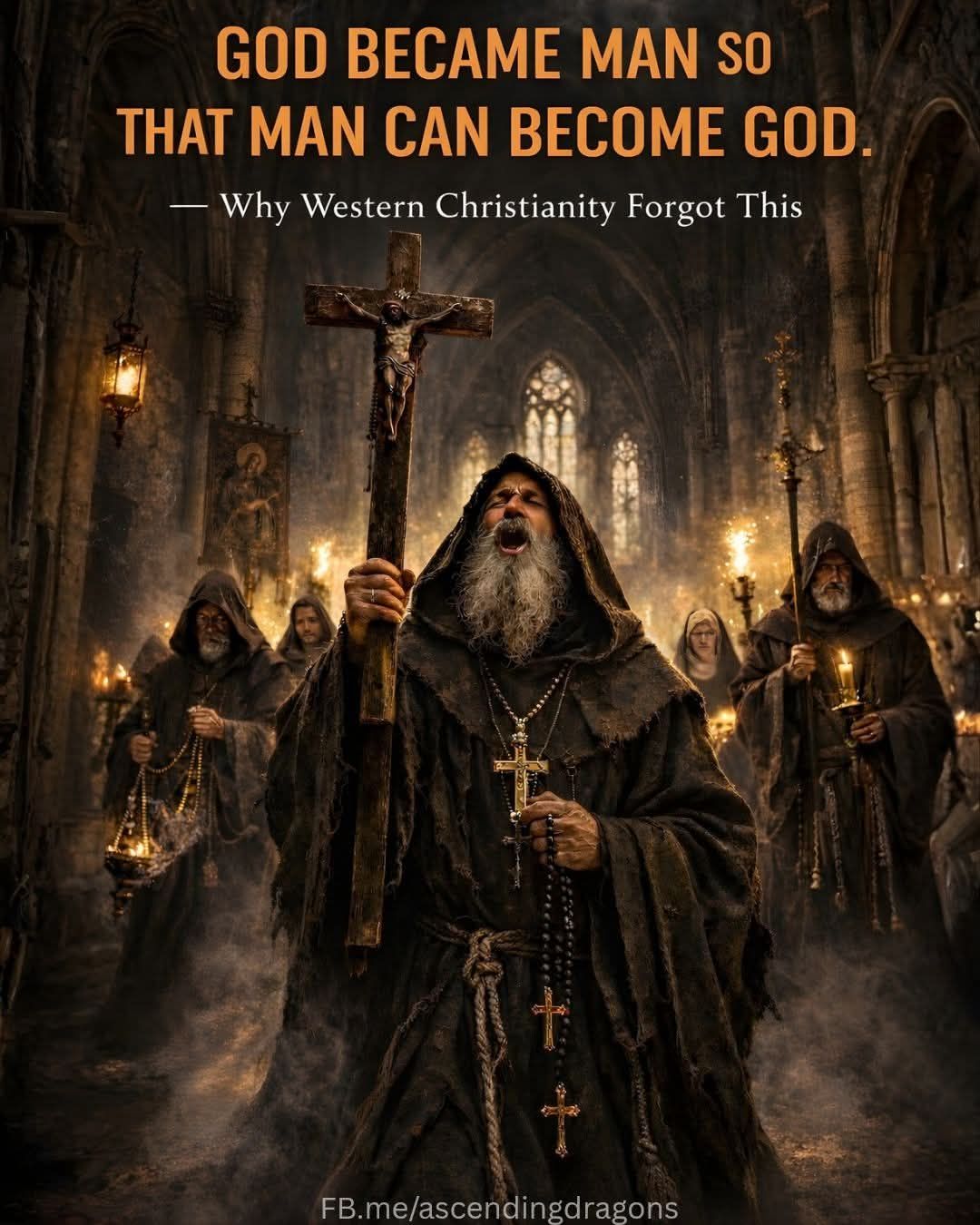
For the first 50 years of my life, I tried piecing together Western Christianity using Christian apologetics — only to find many of the answers unsatisfactory.
I don’t particularly find Christian apologetics to be incredibly useful. I actually find the vast theological discussion across the world far more useful. Theology is rich because it is full of sincere wrestling with mysteries. Certainties and canonizations can feel rigid — but the discussions themselves have often been more sincere.
In the East, there is a doctrine that has been, for me, a bridge between Christian orthodoxy and the other faiths of the world — especially Advaita Vedanta.
That doctrine is Theosis.
WHAT IS THEOSIS — AND WHERE DID IT COME FROM?
Theosis — also called deification or divinization — is the ancient Christian teaching that salvation is not merely forgiveness.
It is participation in the divine life.
The phrase at the top of this post — “God became man so that man might become God” — is most famously attributed to St. Athanasius of Alexandria in the 4th century. Variations of it were echoed by St. Irenaeus, St. Gregory of Nazianzus, St. Basil the Great, and later developed deeply by Maximus the Confessor and the Eastern fathers.
This was not fringe mysticism.
It was mainstream early Christianity.
Eastern Orthodoxy still holds this as standard doctrine.
The idea was simple yet profound:
Christ did not merely come to pay a legal penalty.
He came to unite humanity to God.
Not that we become God by nature — but that we participate in God by grace.
THE MYSTICS WERE CONVINCED OF THIS
Throughout history, mystics across traditions were convinced of this reality — not merely by theology, but by experience.
Christian mystics spoke of union, indwelling, transformation, luminous participation.
Everything that was ego died.
Everything that was flesh-centered died.
What remained was radiant, God-filled consciousness.
Some of them shone — literally, according to accounts.
Some spoke of becoming “all flame.”
Some described losing the self in God without losing personhood.
They weren’t trying to be controversial.
They were describing what they experienced.
And what they experienced matched the ancient doctrine.
SCRIPTURE GIVES CLUES — IF YOU LOOK
What many people don’t realize is that Scripture gives a surprising number of clues.
First off — we are of spiritual essence.
What else would we be made of?
If God is the ground of all being, from what else would we be formed other than from God Himself?
There is a God-spark that animates us.
We are made in the image of God.
We are called children of God.
Scripture speaks of body, soul, and spirit.
The Old Testament says, “You are gods.”
Jesus quotes this.
The New Testament becomes even more overt.
It says we will sit with Christ on His throne.
It says we will be conformed to His likeness.
It says we will rule and reign with Him.
It calls Him the firstborn among many brothers.
That indicates equality of participation — not equality of essence.
Crazy talk, huh?
Paul speaks constantly about mystery — about what we are becoming. About glory that is yet to be revealed.
Even after studying Buddhism and Hinduism, I find this doctrine incredibly fascinating — because when you view Christianity through a mystical lens, you see profound coherence with Eastern metaphysics.
Not identical.
But resonant.
SO WHY DID WESTERN CHRISTIANITY FORGET THIS?
I believe much of this has to do with denominational developments in the West and the particular theological frameworks that took center stage.
Legal metaphors dominated.
Forensic atonement models dominated.
Institutional structures hardened.
Meanwhile, the language of transformation softened.
Theosis remained alive in Eastern Orthodoxy.
It appeared in Western mysticism.
But it never became the dominant emphasis in popular Western Christianity.
And per usual, religious people don’t question much.
They believe what they are told — and for most, that’s enough.
LET’S CIRCLE BACK TO SOMETHING BASIC
We are literally called children of God.
We are made in the image of God.
The clues are right there.
Of course, this is not about the human body becoming divine.
It is about spiritual transformation — or perhaps remembrance.
A flame within us that must be kindled.
Jesus said the Kingdom of Heaven is like a mustard seed.
It starts small but becomes the largest of trees.
The seed was always there.
The spark of divinity was always there.
Kindled by grace.
Cooperated with through discipline.
Guided by the Holy Spirit’s wisdom.
Finished through love.
HOW INCREDIBLE IS THIS?
How incredible is it to think that there have been mystics in the past so enamored, so filled with God, that everything that was ego died — and all that remained was divine participation?
Not annihilation.
Not pantheism.
Not ego inflation.
Participation.
God became man so that man might become God.
Not by nature.
But by grace.
And when you see it — when you really see it — Christianity stops being about legal acquittal and becomes about divine union.
That changes everything.
 Apostolic Pentecostal Network
You must be logged in to post a comment.