
“Therefore be imitators of God, as beloved children.”
— Ephesians 5:1
“And if anyone speaks, let him speak as the oracles of God.”
— 1 Peter 4:11
Scripture does not tell us to imitate fear.
It tells us to imitate God.
That alone raises a a powerful question:
How does God see?
Because if we are to imitate Him, then our perception must begin to align with His.
Many have been taught that God sees sin everywhere.
Yet Scripture reveals something very different.
“God was in Christ reconciling the world to Himself, not counting their trespasses against them.”
— 2 Corinthians 5:19
Not counting.
Not keeping record.
Not holding the ledger.
The ministry of God is reconciliation.
And Paul says clearly:
“Now all things are of God.”
— 2 Corinthians 5:18
If all things are of God, then the question becomes one of perception.
Are we seeing through distortion… or through truth?
The psalmist describes the heart of God this way:
“As far as the east is from the west, so far has He removed our transgressions from us.”
— Psalm 103:12
Think about that.
East and west never meet.
The distance is immeasurable.
If God has removed transgression that completely, then how could humanity still be living under the identity of sin?
How can someone be punished for something God no longer remembers?
The answer is not divine bookkeeping.
The answer is sowing and reaping.
“Do not be deceived: God is not mocked. Whatever a man sows, that he will also reap.”
— Galatians 6:7
People reap the fruit of the identity they sow from.
If someone sows from separation consciousness — believing they are apart from God, striving toward God, living from fear and condemnation — that identity will produce fruit.
And the fruit of separation is death.
“There is a way that seems right to a man, but its end is the way of death.”
— Proverbs 14:12
Even good intentions cannot overcome a distorted root.
But there is another way to sow.
Union consciousness.
The awareness that your life originates in God.
That reconciliation has already been declared.
That love is not something you are trying to earn, but something you are created to live from.
John writes something astonishing:
“Whoever is born of God does not commit sin, for His seed remains in him.”
— 1 John 3:9
The seed of God changes the root.
And when the root changes, the fruit changes.
Paul even describes believers as partners in the work of God:
“For we are co-laborers with God.”
— 1 Corinthians 3:9
Not servants striving for approval.
Co-laborers participating in restoration.
When someone remembers their origin, their life begins to align with love.
And when love becomes the root, the fruit naturally changes.
This is why the gospel is not a message of condemnation.
It is a message of awakening.
“Why, as though living in the world, do you submit to regulations:
‘Do not touch, do not taste, do not handle’?”
— Colossians 2:20–21
Rules cannot restore identity.
Fear cannot produce transformation.
Only truth can.
The wisdom of God is simple:
Return to the origin.
Return to love.
Return to the truth of who you are.
The seed you sow in your heart becomes the life you live.
Sow from separation and you will harvest fear.
Sow from union and love will begin to grow.
Return to your origin and let truth become your harvest.
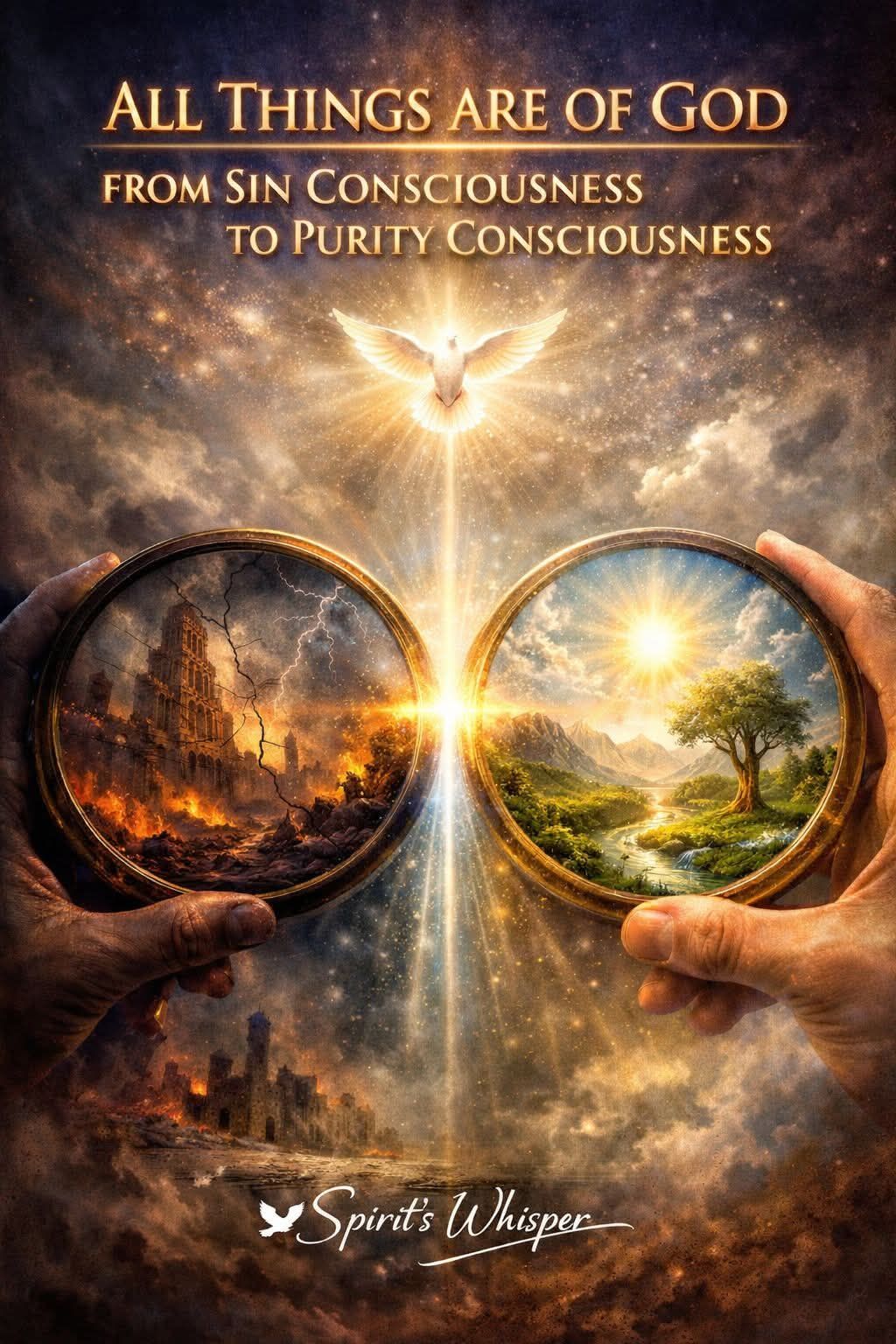
Religion often trained us to look at the world through the lens of contamination.
What is sinful?
What is unclean?
What must be avoided?
But the apostles spoke of something deeper — the transformation of perception.
“Now all things are of God.”
— 2 Corinthians 5:18
“All things were made through Him, and without Him nothing was made that was made.”
— John 1:3
If all things originate in God, then evil cannot be the true nature of creation.
What we are often seeing is not the essence of a thing.
We are seeing distortion.
Just as a mirror can reflect a warped image when bent, the human heart can distort what was originally whole.
This is why Paul wrote:
“To the pure, all things are pure.”
— Titus 1:15
Purity is not pretending harm does not exist.
Purity is the clarity that allows us to see what is true beneath distortion.
When people hear this, they often respond with the same objection:
“So are you saying that harm, abuse, or evil actions are acceptable?”
No.
Not at all.
Distortion is real.
But distortion is not the original design.
When someone acts in violence, cruelty, or abuse, we are not seeing the image of God in its clarity.
We are seeing a human soul operating through fracture, trauma, fear, and separation.
The behavior is distorted fruit.
But fruit always grows from a root.
And if we only curse the fruit, we never heal the root.
This is why the Spirit teaches us to see differently.
Paul said:
“From now on we regard no one according to the flesh.”
— 2 Corinthians 5:16
To see someone “according to the flesh” is to reduce them to their distortion.
To see someone through the Spirit is to recognize the deeper reality beneath the distortion.
This does not mean we allow harm.
Love never protects abuse.
Truth never excuses injustice.
But the Spirit reveals something deeper than condemnation.
The Spirit reveals the root.
When the root is healed, the fruit changes.
When the distortion is illuminated, the image of God begins to reappear.
Jesus demonstrated this constantly.
He saw beyond the surface behavior of people.
He saw the woman others condemned and restored her dignity.
He saw the tax collector others despised and called him by name.
He saw fishermen and spoke to kings hidden inside them.
He did not deny distortion.
He healed it.
And the way He healed it was by seeing the truth beneath it.
This is the movement from sin-consciousness to purity-consciousness.
Sin-consciousness fixates on what is broken.
Purity-consciousness sees what was always whole beneath the fracture.
When the heart becomes pure, the lens becomes clear.
And when the lens becomes clear, you begin to see what the Spirit sees:
Not just what people have become…
but what they were always created to be.
Distortion is loud, but truth is deeper.
Look beyond the broken fruit and ask what root needs healing.
When the heart learns to see clearly, compassion replaces condemnation.
And what once looked hopeless becomes the beginning of restoration.
 Apostolic Pentecostal Network
You must be logged in to post a comment.