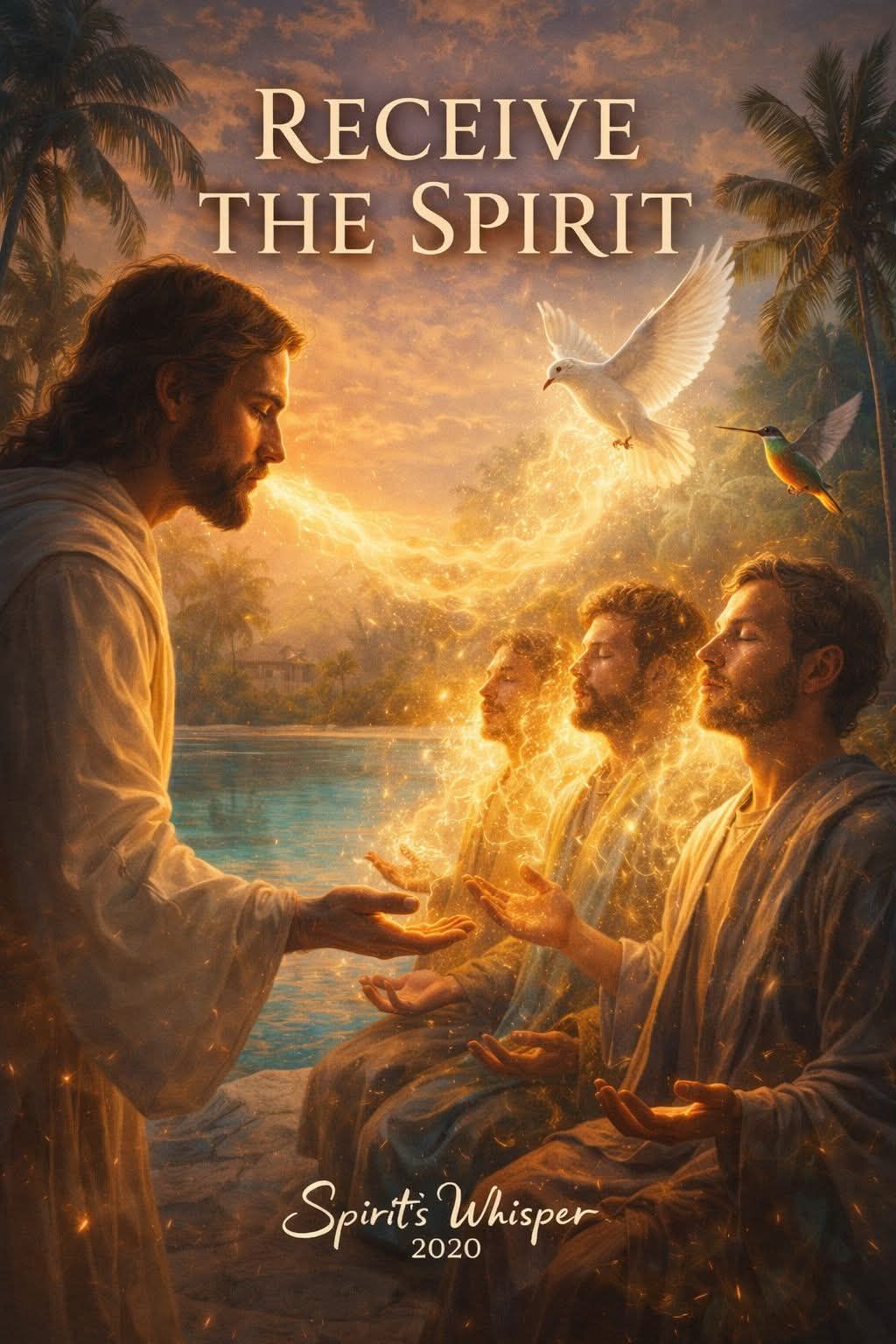
“And when He had said this, He breathed on them and said to them, ‘Receive the Holy Spirit.’”
John 20:22
Most people read this as a transfer.
As if the disciples were empty vessels,
and Jesus walked up and injected them
with something they did not have.
But slow down.
John is not careless with language.
The word used for “breathed on” is ἐνεφύσησεν — enephusēsen.
That word appears only here in the New Testament.
But it appears in the Greek version of Genesis 2:7.
“And God breathed into Adam’s nostrils the breath of life.”
John is not writing randomly.
He is echoing creation.
First Adam.
Breath.
New Adam.
Breath.
This is new creation language.
Now look at the word “receive.”
Greek: λάβετε — labete.
From lambanō.
It means:
to take,
to lay hold of,
to grasp,
to receive what is offered.
It does not automatically mean
to create something out of nothing.
It means to take hold of.
And the word “Spirit” is pneuma.
Breath.
Wind.
Life-force.
In ancient Jewish thought,
breath and spirit were inseparable.
You did not own spirit like an object.
You participated in it.
So what is happening here?
Is Jesus installing something foreign?
Or is He awakening them
to what they already carry?
Earlier in John 14:17, He says:
“He dwells with you and will be in you.”
Genesis already tells us humanity was animated by divine breath.
So what if this moment is not implantation,
but revelation?
Not distribution,
but activation.
Not giving,
but unveiling.
He breathes to mirror Genesis.
He speaks to awaken awareness.
Receive.
Take hold.
Recognize.
Breath is intimate.
Breath is invisible yet undeniable.
Breath cannot be possessed.
It can only be consciously participated in.
When He says “Receive the Spirit,”
He is not handing them a substance.
He is revealing their source.
He is saying:
Become aware.
Lay hold of.
Step into what you already are.
John places this at resurrection.
Luke places empowerment at Pentecost.
Different emphases.
John writes mystically.
Luke writes narratively.
But John is showing us something deeper:
Resurrection is not merely an event.
It is a revelation of identity.
The new creation is not external.
It is awakened from within.
So when you read,
“Receive the Spirit,”
Ask yourself:
Does it sound like an outside transaction?
Or a remembering?
Does it feel like something arriving from above?
Or something rising from within?
The breath was always there.
The awakening was not.
You are not waiting to be filled.
You are waking up to what fills you.
The breath you seek
is already breathing you.
 Apostolic Pentecostal Network
You must be logged in to post a comment.