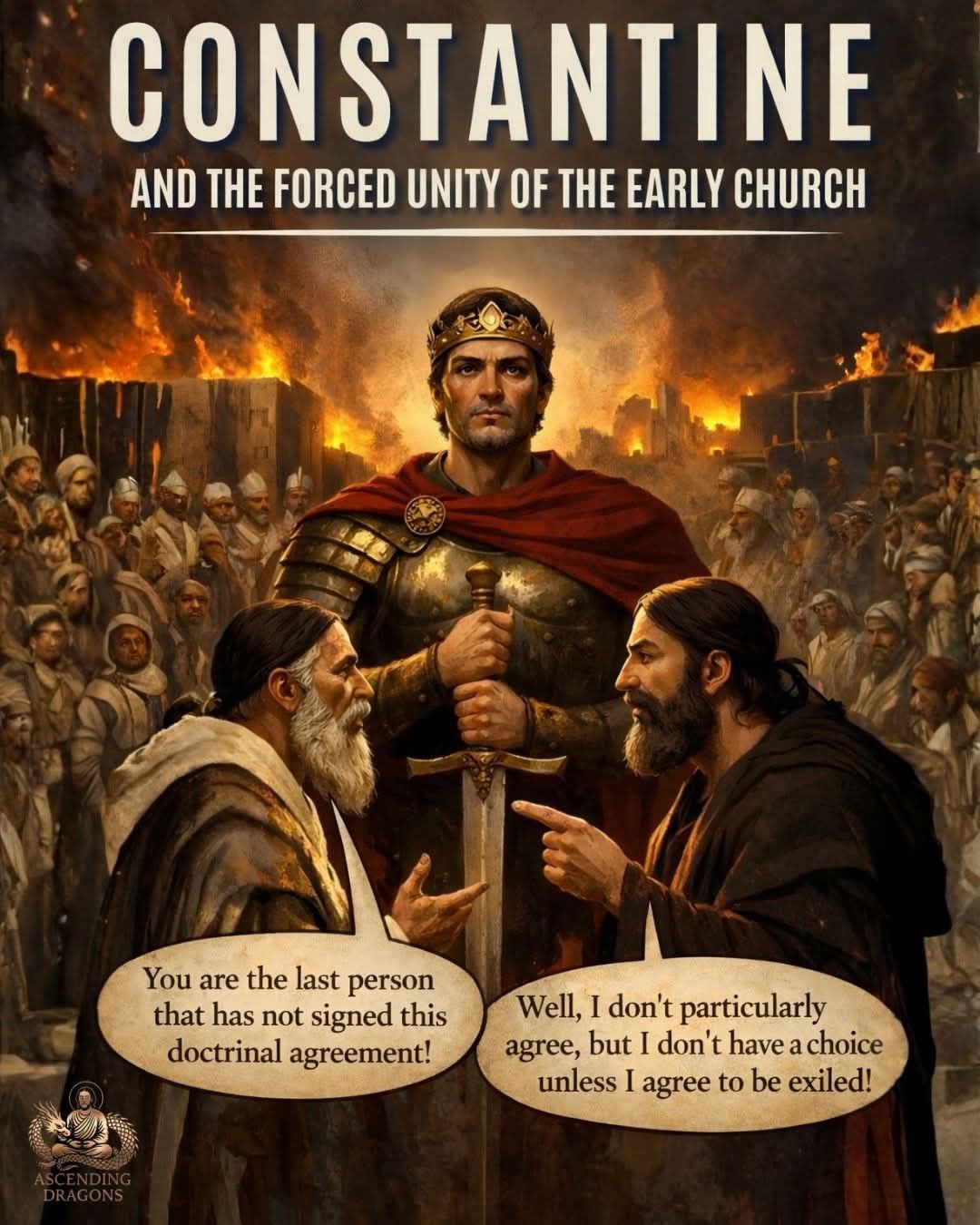
The Day Disagreement Became Exile
—
CERTAINTY REPLACES MYSTERY 🔍
Ladies and gentlemen, certainty has replaced mystery, and forced unity has replaced natural unity.
There is a lot of unity in this world that is forced. Any situation in a family or in a government that is essentially coerced from fear should make us pause.
It kind of reminds me of those pictures of Vladimir Putin sitting at a huge table, with everyone else sitting extremely far away. They’re all acting nice, polite, and respectful — but behind the scenes they are scared as hell.
That’s not real unity.
That’s forced unity.
And historically speaking, this was very much the case with the Roman Empire.
—
—
GIVING THE ROMAN EMPIRE TOO MUCH CREDIT ⚔️
I think Christianity today gives the Roman Empire way too much credit.
Many Christians talk about this period as if the entire process was just completely divinely orchestrated — as if there was no humanity involved and it was simply a perfect journey of integrity guided from heaven.
But this is just not true.
Constantine pushed for unity because he feared the effects that disunity would have on the empire.
Make no mistake — he wasn’t doing this purely out of some sincere devotion to God.
He may very well have had faith in God. That’s entirely possible.
But high positions like emperor come with divided loyalties by definition.
Few people can handle that level of authority with total integrity.
And I highly doubt that the emperor of the Roman Empire was able to do so.
—
—
WHAT ACTUALLY HAPPENED AT NICEA 📜
When it came to the debates about Jesus — his divinity, his nature, the Trinity, and many other theological questions — the first two great councils were structured in a very particular way.
The Council of Nicaea and later the Council of Constantinople were not simply open-ended conversations that allowed disagreement to continue indefinitely.
They were more like deliberations that had to reach a unified conclusion.
In many ways it functioned similarly to how the Roman Catholic Church elects a pope today. The discussion continues until the group eventually reaches a unified agreement.
But here is a detail many people conveniently forget.
At the end of the Council of Nicaea, there were two bishops who refused to sign the doctrinal agreement.
They disagreed strongly enough that they were exiled.
Yes.
Exiled.
Yay! Unity!
—
—
UNITY OR COERCION? ⚖️
Come on guys, it’s pretty obvious what was happening here.
This was not a perfectly righteous process.
Now to be fair, I actually think the early church did a fairly good job trying to understand the New Testament documents with the philosophical tools available to them at the time.
The problem for me isn’t that they debated these questions.
The problem is the forced unity.
Instead of allowing the conversation to continue…
Instead of allowing mystery…
Instead of allowing different interpretations to exist while truth matured over time…
Unity was forced.
—
—
THE TRINITY AS A PERFECT EXAMPLE 🔍
Take the Trinity for example — which, by the way, is a famously confusing doctrine.
Over the centuries there have been numerous views and debates surrounding it.
Different theologians tried to explain how Jesus could be divine, how the Father and Spirit relate to him, and how God could be one while also expressed in multiple ways.
This is a perfect example of an idea that might actually belong in the category of mystery.
In fact, I don’t even think allowing the exact metaphysics of Jesus’ divinity to remain mysterious would necessarily be a terrible thing.
What matters most is genuine faith and obedience to the Spirit that he brought into the world.
—
—
WE ACTUALLY KNOW MORE TODAY 🧠
The philosophers and theologians of the early church were brilliant for their time.
Their philosophical framework was incredibly advanced for the ancient world.
But today we have access to things they never had.
We have two thousand additional years of philosophical reflection.
We have a broader understanding of consciousness.
We have thousands of documented near-death experiences that shed new light on spiritual reality.
In many ways, we are actually in a better position today to explore these mysteries than they were.
—
—
THE MODERN VERSION OF EXILE 🚪
But interestingly enough, this conversation rarely happens in Christianity today.
If you question the Trinity…
If you explore alternative interpretations…
If you suggest that the Christ reality might be larger than a single doctrinal definition…
You won’t be exiled from the Roman Empire like people were in the fourth century.
But you will often be:
• mocked
• dismissed
• belittled
• socially excluded
In other words…
The exile still exists.
It just looks good.
 Apostolic Pentecostal Network
You must be logged in to post a comment.