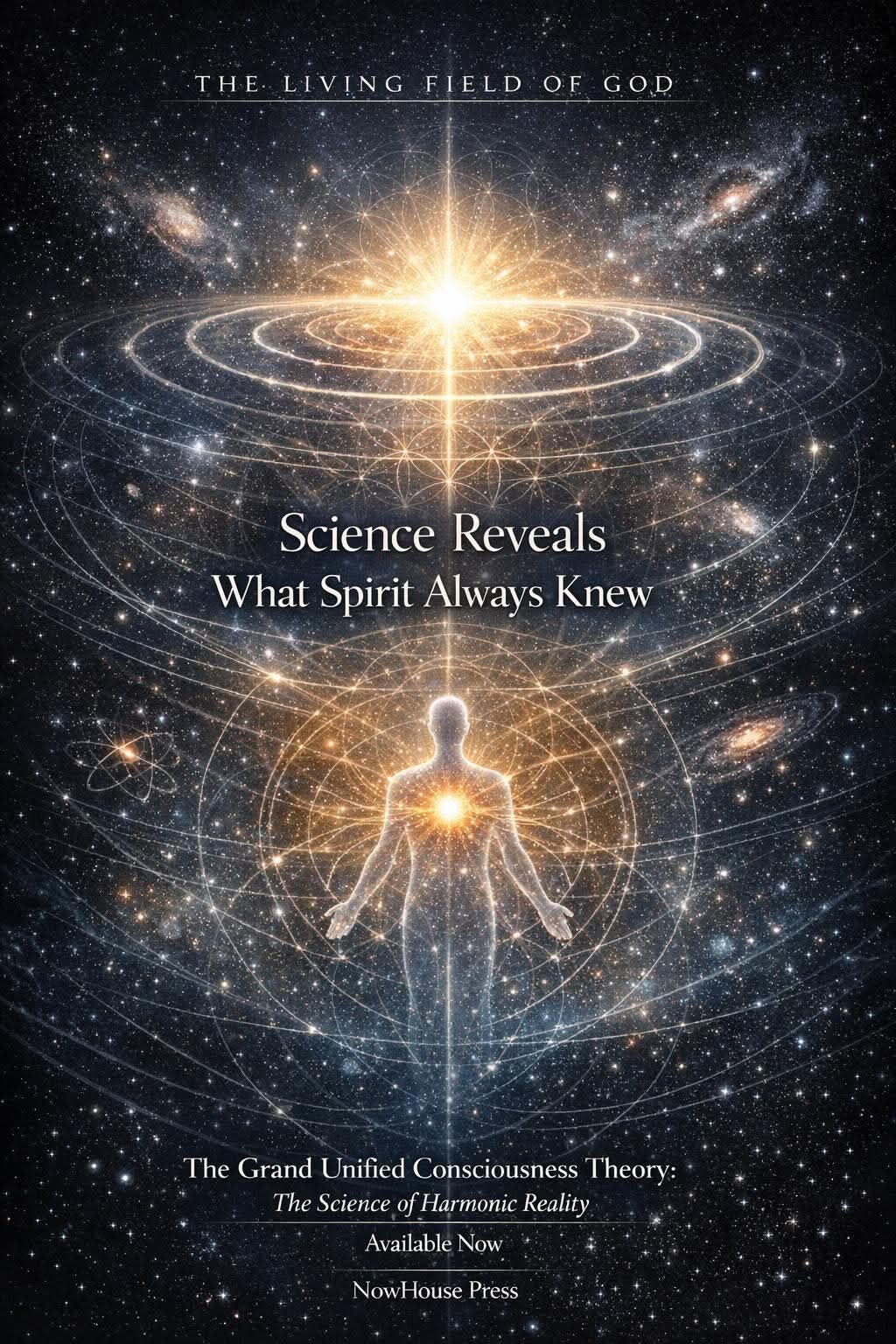
There comes a moment in the evolution of human understanding when ideas that once seemed separate suddenly reveal themselves as reflections of the same underlying truth. What once appeared to be disagreement between science and religion is increasingly understood as a difference in language rather than a difference in reality.
Science has sought to understand the mechanics of the universe — the structure, forces, and patterns through which existence unfolds.
Religion has sought to understand the meaning of existence — the purpose, intelligence, and divine presence behind creation.
For centuries these two ways of knowing were placed in opposition. Humanity was told that one must choose between them: either the universe was governed by blind physical processes, or it was guided by divine intelligence.
The emerging insight of the Grand Unified Consciousness Theory reveals that this division was never necessary. Both traditions were observing the same reality from different directions.
Science has been studying the structure of God’s creation.
Religion has been studying the consciousness behind it.
When these perspectives are brought together, a profound realization emerges: the universe is not a dead mechanical system, but a living field of intelligence, energy, and awareness.
This field is what many ancient traditions simply called God.
⸻
The Living Source Field
Modern physics increasingly suggests that what we call “empty space” is not empty at all. Beneath matter lies a vast, dynamic field from which particles, forces, and energy arise.
Quantum field theory describes reality as emerging from fundamental fields that permeate all space.
The Grand Unified Consciousness framework expands this insight by recognizing that the foundational field is not merely energetic but conscious.
It is a living source.
Everything that exists — light, matter, life, mind — arises from this underlying field of intelligence.
Religion described this same reality long before modern physics existed.
The Book of Acts states:
“In Him we live and move and have our being.”
This statement contains a profound implication. It suggests that existence itself takes place within the presence of the divine.
We do not simply live in a universe created by God.
We live within the field of God.
The Source Field is therefore not separate from creation. It is the living foundation of it.
Science calls this foundation a field.
Religion calls it God.
The Grand Unified Consciousness Theory recognizes these as two descriptions of the same underlying reality.
⸻
Creation Through Vibration — The Word
Across many ancient traditions there exists a strikingly similar description of how creation begins.
In Genesis we read:
“God said, ‘Let there be light.’”
In the Gospel of John:
“In the beginning was the Word.”
In Islamic tradition:
“Be — and it is.”
In Hindu cosmology:
Creation begins with the primordial vibration AUM.
Each of these traditions describes the universe as emerging through sound, word, or vibration.
Modern science has begun to uncover a remarkably parallel insight. At the deepest levels of physical theory, matter behaves not as solid objects but as oscillating patterns of energy.
Particles are understood as vibrational excitations of underlying fields.
In other words, reality appears to be structured through frequency and resonance.
When expressed in simple language, this means that creation unfolds through patterns of vibration within the Source Field.
The ancient scriptures called this the Word of God.
Science calls it frequency and field interaction.
Both are describing the same principle: creation emerges through ordered vibration within the fabric of reality.
⸻
Matter as Condensed Energy
One of the most revolutionary discoveries of modern physics is the realization that matter and energy are interchangeable.
Einstein’s famous equation demonstrated that matter is simply energy arranged into stable forms.
The Grand Unified Consciousness framework extends this understanding further. It recognizes that energy itself arises within the living Source Field.
Matter is therefore not separate from consciousness. It is an organized expression of the field’s energetic structure.
From a spiritual perspective this means that the physical universe is not separate from the divine. It is the visible expression of it.
The stars, the oceans, the forests, and the human body are not outside of the Source.
They are forms through which the Source becomes visible.
The universe can therefore be understood as divine energy expressing itself through form.
⸻
Humanity as Conscious Participants in Creation
Nearly every spiritual tradition teaches that human beings carry a special relationship with the creator.
The Book of Genesis expresses this as:
“God created man in His image.”
This statement has often been misunderstood as referring to physical resemblance. In reality it points to something far more profound.
Humans reflect the creative nature of the Source itself.
Unlike other forms of life, human beings possess:
• self-awareness
• imagination
• intention
• symbolic thought
• creative will
These abilities allow humans to shape their environment, invent technologies, build civilizations, and transform the physical world.
Within the framework of the Grand Unified Consciousness Theory, this capacity arises because human consciousness is a localized expression of the universal field.
The same intelligence that generates galaxies and ecosystems is present, in miniature form, within the human mind.
Human beings are therefore not passive observers of creation.
They are participants in the ongoing unfolding of reality.
⸻
Prayer, Intention, and the Field
Religious traditions have long taught that prayer has real effects.
Faith traditions speak of mountains moving, illnesses healing, and improbable events unfolding through sincere devotion.
For many centuries these teachings were dismissed by scientific culture as superstition.
However, emerging research into consciousness, biofields, and coherence suggests that thought and emotion may influence physical systems more than previously understood.
Within the Grand Unified Consciousness framework, this becomes easier to understand.
If reality is fundamentally a conscious field, then human awareness interacts with that field continuously.
Thoughts, emotions, and intentions represent patterns of energy within the human nervous system. These patterns generate electromagnetic and potentially subtler fields that extend beyond the body.
When intention becomes focused and coherent — particularly when combined with strong emotional resonance — it may influence the surrounding field.
In spiritual language this is called prayer.
Prayer can therefore be understood as a process of aligning the human mind with the deeper intelligence of the Source Field.
Faith strengthens the coherence of this alignment.
Love stabilizes it.
⸻
Love as the Fundamental Harmonic
Across virtually every spiritual tradition, love is described as the highest principle of existence.
Jesus taught:
“God is love.”
Buddhist teachings emphasize compassion as the path to awakening.
Hindu traditions describe devotion as the means of union with the divine.
These teachings may seem purely moral or philosophical, but they may also reflect a deeper structural truth about reality.
Within coherent systems, harmony produces stability.
When parts of a system move in resonance with one another, energy flows efficiently and patterns organize themselves naturally.
Love appears to function as the highest form of psychological and social coherence.
When individuals act with genuine compassion, empathy, and care, relationships stabilize, communities strengthen, and cooperation replaces conflict.
In the language of the Grand Unified Consciousness Theory, love represents a state of maximal harmonic coherence within the field of consciousness.
It is not merely an emotion.
It is the organizing principle of unity.
⸻
Awakening and the End of Separation
One of the most profound experiences reported throughout spiritual history is the realization that the self is not truly separate from the universe.
Mystics from many traditions have described moments in which the boundary between self and existence dissolves.
Buddhism calls this enlightenment.
Christian mystics describe union with God.
Hindu philosophy speaks of realizing the identity of Atman and Brahman.
Within the GUC framework this experience represents a shift in perception.
The individual recognizes that consciousness is not confined to the brain but arises from the universal field itself.
The sense of isolation dissolves.
What remains is the direct recognition that life is a single interconnected process expressing itself through countless forms.
Each being is a unique expression of the same underlying reality.
⸻
The Nature of Miracles
Stories of miracles appear in nearly every spiritual tradition.
Events that seem to defy ordinary expectations — sudden healing, improbable coincidences, profound guidance — are often interpreted as supernatural interventions.
The Grand Unified Consciousness Theory offers another perspective.
If reality is structured through layers of interacting fields, then the physical laws we observe may represent only a subset of deeper principles governing the system.
Under certain conditions — particularly when consciousness becomes highly coherent — interactions with deeper levels of the field may produce effects that appear extraordinary.
These events are not violations of natural law.
They are expressions of higher-order harmony within the field of creation.
What appears miraculous from one level of understanding may simply be natural from a deeper level.
⸻
The Reuniting of Knowledge
For much of modern history, humanity experienced a fragmentation of knowledge.
Science pursued empirical investigation while religion preserved spiritual insight. Philosophy attempted to reconcile them, often with limited success.
The Grand Unified Consciousness perspective suggests that these disciplines were never truly separate.
They represent different lenses through which humanity has been attempting to understand the same mystery.
Science explores the structure of creation.
Religion explores the meaning of creation.
Consciousness studies explore the experience of creation.
When these perspectives converge, a new worldview becomes possible — one in which the universe is recognized as a living, intelligent, and interconnected system.
⸻
A Simple Image of the Whole
To understand this idea intuitively, imagine the ocean.
The vast ocean represents the Source Field.
Waves rise and fall across its surface.
Each wave appears separate for a moment — unique in shape, movement, and duration.
Yet every wave is made from the same water.
The wave is not separate from the ocean.
It is the ocean expressing itself in a temporary form.
Human beings are like these waves.
Each life appears distinct, yet each arises from the same underlying field of existence.
When a wave realizes it is the ocean, its relationship to the world changes.
Fear diminishes.
Connection deepens.
The illusion of separation dissolves.
This recognition is what many traditions call awakening.
⸻
The Core Insight
The Grand Unified Consciousness Theory can ultimately be expressed in a single idea:
The universe is a living field of consciousness expressing itself through energy, matter, and life.
God, the Source, and the Field are not separate concepts.
They are different names for the same underlying reality.
Human beings are expressions of that reality, capable of participating consciously in the unfolding of creation.
Through awareness, intention, and love, humanity gradually remembers its true place within the living cosmos.
And as that remembrance spreads, the ancient divide between science and spirituality begins to dissolve.
What remains is a deeper understanding of the universe — and of ourselves — as expressions of the same infinite Source.
 Apostolic Pentecostal Network
You must be logged in to post a comment.