A young Catholic once asked his catechist:
“Why does the Catholic Church follow both Scripture and Tradition? Shouldn’t the Bible alone be enough?”
The catechist smiled and replied:
“Let me ask you a question first. Before the New Testament was written, how did Christians know what Jesus taught?”
The young man paused.
He had never thought about that.
For years after Jesus’ Resurrection, there was no complete New Testament.
Yet thousands of people believed in Christ, were baptized, celebrated the Eucharist, and faithfully lived the Christian life.
How?
To answer this, we need to begin with a story from the Bible.
After His Resurrection, Jesus gathered His Apostles before ascending into Heaven.
He did not hand them a New Testament.
Instead, He gave them a mission.
He said:
“Go, therefore, and make disciples of all nations… teaching them to observe all that I have commanded you.” (Matthew 28:19-20)
The Apostles went throughout the world preaching the Gospel.
They taught people by word of mouth.
They celebrated the sacraments.
They established churches.
Only later did some of them begin writing letters and Gospels, which eventually became the New Testament.
This helps us understand why the Catholic Church treasures both Scripture and Tradition.
First, Jesus Taught More Than What Was Written.
The Gospels themselves tell us that Jesus did many things that were never recorded in writing.
Saint John concludes his Gospel by saying:
“There are also many other things that Jesus did, but if these were to be described individually, I do not think the whole world would contain the books that would be written.” (John 21:25)
Not everything Jesus taught was immediately written down.
Second, The Apostles Handed On the Faith Both Orally and in Writing.
The Apostles preached long before the New Testament was completed.
Saint Paul even instructed Christians:
“Stand firm and hold fast to the traditions that you were taught, either by an oral statement or by a letter of ours.” (2 Thessalonians 2:15)
Notice that Paul places both oral teaching and written teaching together.
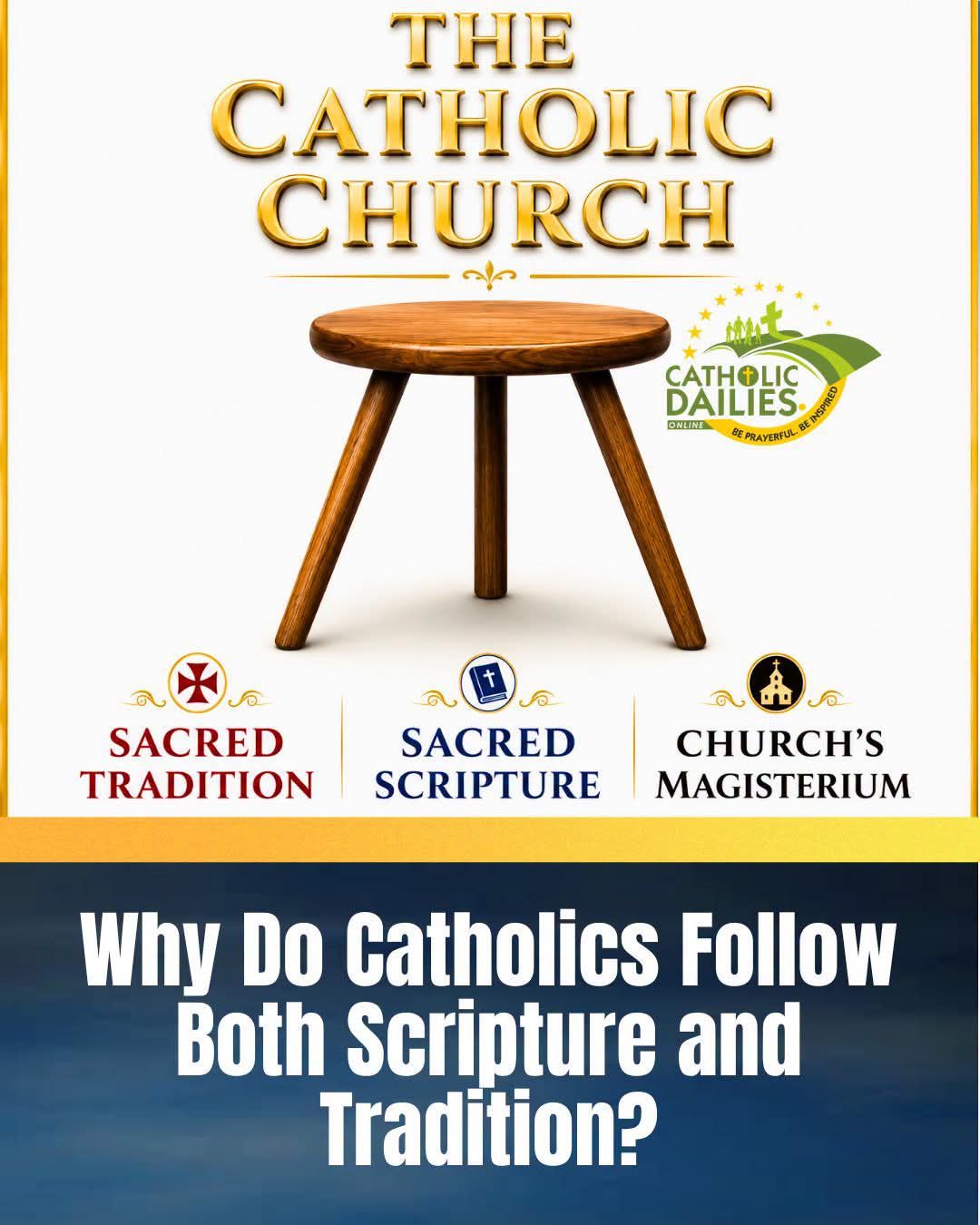
This is what the Church calls Sacred Tradition and Sacred Scripture.
Third, Sacred Tradition Is Not Human Tradition.
When Catholics speak of Tradition with a capital “T,” they do not mean customs that people invented over time.
Sacred Tradition is the living transmission of Christ’s teaching entrusted to the Apostles and faithfully handed on under the guidance of the Holy Spirit.
It comes from the same divine source as Sacred Scripture.
Fourth, Scripture and Tradition Cannot Contradict Each Other.
Because both come from God, Sacred Scripture and Sacred Tradition always agree.
If something truly contradicts the Bible, it cannot be authentic Sacred Tradition.
The Church carefully safeguards both so that the faith handed down by the Apostles remains unchanged.
Fifth, The Church Serves Both Scripture and Tradition.
Jesus entrusted the Apostles-and their successors-with preserving His teaching.
The Church does not stand above God’s Word.
Rather, she faithfully guards, explains, and hands on both Sacred Scripture and Sacred Tradition so that every generation receives the same Gospel.
Finally, the Catholic Church follows both Scripture and Tradition because both were entrusted by Christ to the Apostles. Scripture is God’s inspired written Word. Tradition is God’s revealed Word faithfully handed on through the Apostles before and alongside the writing of the New Testament. Together, under the guidance of the Church’s Magisterium, they form one sacred deposit of faith.
In simple words, Catholics do not believe in choosing between Scripture and Tradition.
We believe both come from Jesus Christ.
The Apostles first preached the Gospel, then wrote part of it down.
The Church faithfully preserves both the written Word of God and the apostolic teaching that was handed on orally.
Now you know.
SOURCES
Sacred Scripture (Catholic Translation):
Matthew 28:18-20
– John 21:24-25, Acts 2:42, 2 Thessalonians 2:15, 2 Timothy 2:2, 1 Corinthians 11:2, 2 Peter 1:20-21
Catechism of the Catholic Church §§74-100
 Apostolic Pentecostal Network
You must be logged in to post a comment.