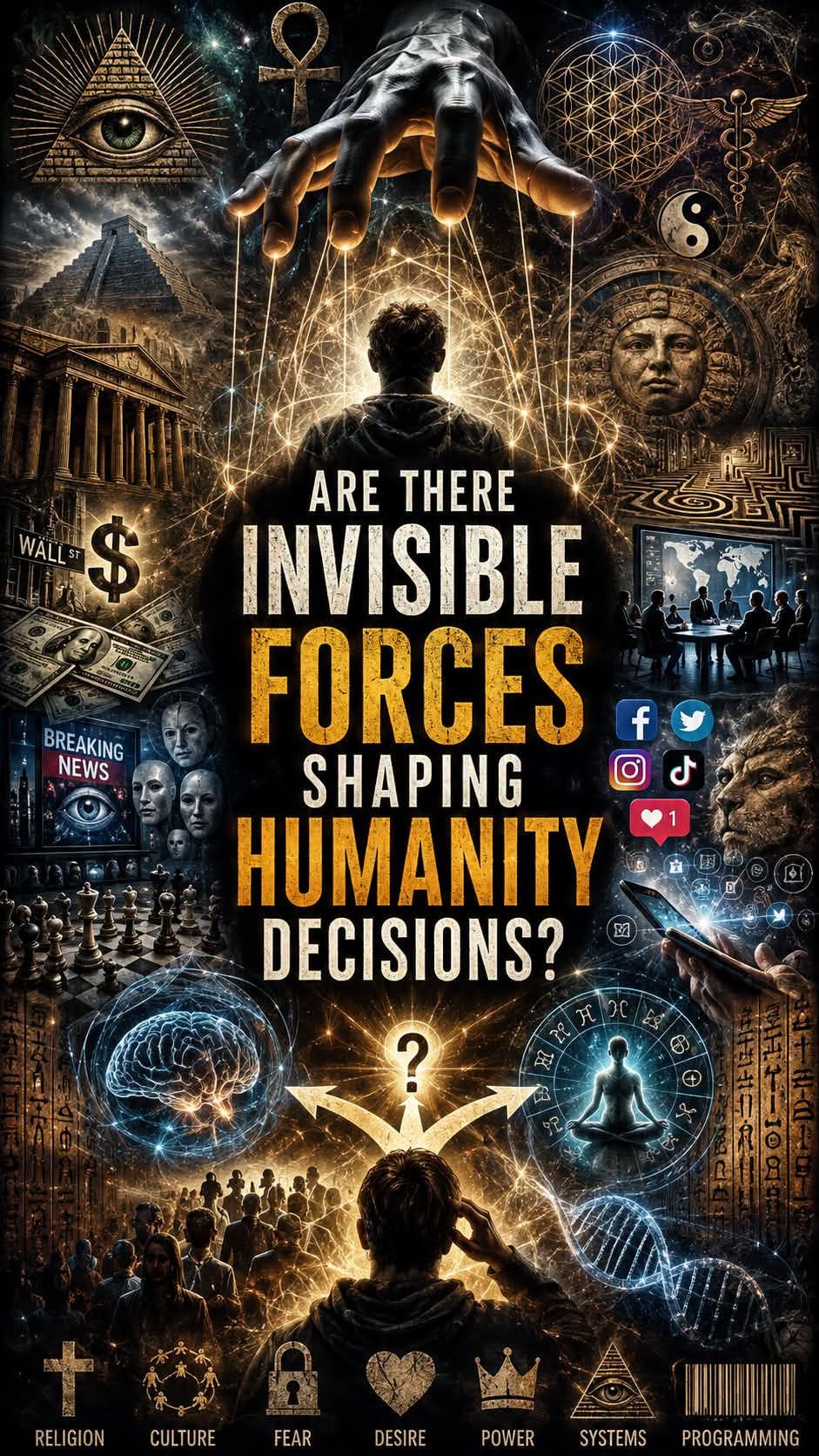
What this image is really asking is far more unsettling than “Who is controlling humanity?”
It is asking:
How much of what you call a decision was actually chosen by you—and how much was produced inside you before you became conscious of choosing?
The deepest revelation is that the most powerful forces shaping humanity may not need to be invisible entities at all. Many are invisible processes: conditioning, incentives, emotions, social expectations, biological drives, memories, algorithms, language, institutions, trauma, culture, fear, desire, and repeated patterns.
1. The “invisible force” is not necessarily supernatural
The image deliberately surrounds the human figure with ancient symbols, religion, money, technology, media, geometry, DNA, social platforms, psychology and systems.
That is important.
Human beings often search for an external force behind their lives while overlooking the forces operating through their own nervous system, perception and learned behavior.
A person can sincerely believe:
“I chose this.”
Yet that choice may have been influenced by:
• what they were taught was desirable,
• what they were punished for rejecting,
• what their family normalized,
• what their culture celebrated,
• what their environment rewarded,
• what they fear losing,
• what they desire possessing,
• what information repeatedly entered their attention,
• what their brain learned through previous experiences,
• and what their present emotional state makes seem true.
The force doesn’t have to command you.
It can simply shape the conditions under which you choose.
⸻
2. The puppet strings represent something deeper than manipulation
The hand at the top of the image is deliberately ambiguous.
It can represent institutions, culture, economics, media, technology, ideology, authority, social pressure—or even the unconscious mind itself.
But there is an even deeper interpretation:
A puppet does not necessarily know it is a puppet.
That is the disturbing part.
If someone has never examined their programming, the programming can feel indistinguishable from identity.
“I am this way.”
“I believe this.”
“I would never do that.”
“This is just who I am.”
But sometimes:
“Who I am” is partly “what I repeatedly learned to be.”
⸻
3. The brain at the bottom changes the entire question
The brain symbolizes the translator between what happens and what it means to you.
Reality presents information.
The nervous system processes it.
The brain interprets it.
Memory compares it with the past.
Emotion assigns significance.
Language gives it a name.
Belief organizes it.
Then consciousness experiences the resulting interpretation as “my reality.”
This means two people can encounter the same event and experience entirely different realities.
The event may be identical.
The internal translation is not.
That is why mastering perception is more fundamental than merely accumulating information.
⸻
4. The DNA symbol points toward inherited influence
DNA does not mean that destiny is genetically predetermined.
It represents something subtler:
You entered life carrying biological inheritance before you developed a personal philosophy.
Your body arrived before your worldview.
Your nervous system developed before your ideology.
Your instincts existed before your vocabulary.
Your developmental environment began shaping you before you could consciously consent to it.
And then family, language, culture and society continued the process.
So the question becomes:
Where does “myself” actually begin?
And where does inherited programming end?
That boundary is much less obvious than humanity often assumes.
⸻
5. The money, Wall Street and corporate imagery represent incentive architecture
Money doesn’t merely purchase things.
It can organize behavior.
People choose careers because of financial incentives.
Companies design products around attention and profit.
Governments create policies around competing interests.
Consumers modify behavior according to prices.
People sometimes remain in environments they dislike because leaving carries an economic cost.
This doesn’t require a secret conspiracy.
It is an example of something much more powerful:
systems can influence behavior simply by rewarding some actions and making other actions expensive.
The invisible force is sometimes simply the incentive structure surrounding you.
⸻
6. The social-media symbols represent the economics of attention
This may be one of the most important symbols in the entire image.
Human attention is limited.
Modern systems compete for it.
Notifications, likes, outrage, novelty, fear, controversy, beauty, status and belonging can repeatedly pull attention toward particular stimuli.
And whatever repeatedly captures attention can eventually influence:
what you think about.
What you repeatedly think about can influence:
what you believe.
What you repeatedly believe can influence:
what you expect.
What you repeatedly expect can influence:
what you do.
And repeated actions become:
patterns.
That is why attention is not merely a psychological resource. It is part of the architecture through which behavior is shaped.
⸻
7. Religion and ancient symbols reveal another layer
The religious and ancient imagery should not automatically be interpreted as evidence that ancient civilizations possessed some secret system controlling humanity.
A more intellectually honest interpretation is that humanity has always used symbols to compress enormous ideas into recognizable forms.
The cross.
The eye.
The ankh.
The pyramid.
The serpent.
The circle.
The crown.
The labyrinth.
The sacred geometry.
These symbols have appeared in different cultures with different meanings.
They reveal something profound about humanity itself:
Humans don’t merely live in physical environments. We live inside symbolic environments.
And symbols can influence behavior because humans attach meaning to them.
⸻
8. The maze represents the human condition
Look closely at the labyrinth-like imagery.
A maze has an interesting property:
You can be moving while still being lost.
Human beings can spend decades being extremely busy without ever questioning the destination.
Work.
Consume.
Compete.
Reproduce.
Accumulate.
Defend.
Compare.
Scroll.
Repeat.
And eventually ask:
“Why am I living this way?”
The question itself can become the beginning of awakening.
⸻
9. The forked path represents conscious participation
The person standing before multiple directions is perhaps the most important figure in the image.
Because the image isn’t ultimately saying:
“You are controlled.”
It is asking:
“Can you become conscious of what influences you?”
Awareness doesn’t necessarily eliminate influence.
It changes your relationship with influence.
Fear can still arise.
Desire can still arise.
Social pressure can still exist.
Algorithms can still compete for attention.
Cultural conditioning can still operate.
Biological impulses can still emerge.
But consciousness can create a space between:
stimulus → interpretation → response.
And within that space, greater choice becomes possible.
⸻
The deepest revelation
Perhaps the greatest invisible force shaping humanity is not one hidden force.
It is the interaction of thousands of visible and invisible forces operating simultaneously.
Biology shapes behavior.
Behavior reinforces habits.
Habits reinforce identity.
Identity filters perception.
Perception influences decisions.
Decisions create consequences.
Consequences reinforce beliefs.
Beliefs influence future decisions.
And around all of this sits society.
Family.
Education.
Religion.
Economics.
Politics.
Technology.
Culture.
Language.
History.
Memory.
Environment.
Relationships.
The result is an extraordinarily complex feedback system.
And humanity often calls the final output:
“Me.”
⸻
But there is an even deeper question
If the mind has been conditioned before it became capable of questioning its conditioning…
who is doing the questioning?
That is where your image moves from psychology into philosophy, spirituality and consciousness.
Because the moment you can observe:
“This is my fear.”
“This is my conditioning.”
“This is my desire.”
“This is the belief I inherited.”
“This is the pattern I learned.”
you have created a distinction between the observer and the observed.
And that distinction is extraordinarily important.
You may not be able to control every force acting upon you.
But you can begin discovering which forces you have unconsciously surrendered your participation to.
That is where self-awareness becomes more than self-knowledge.
It becomes liberation from unconsciousness.
And perhaps this is why the ancient spiritual traditions repeatedly pointed inward.
Not because everything outside you is irrelevant—
but because the kingdom you are searching for externally may first require you to understand the kingdom operating within you.
The ultimate question raised by this image therefore isn’t:
“Who is controlling humanity?”
It is:
“How much of what I call free will have I actually examined?”
And perhaps even more disturbing:
“If I have never examined the forces shaping my choices, can I honestly say I am choosing—or merely continuing?”
 Apostolic Pentecostal Network
You must be logged in to post a comment.