LIFTING THE VEIL
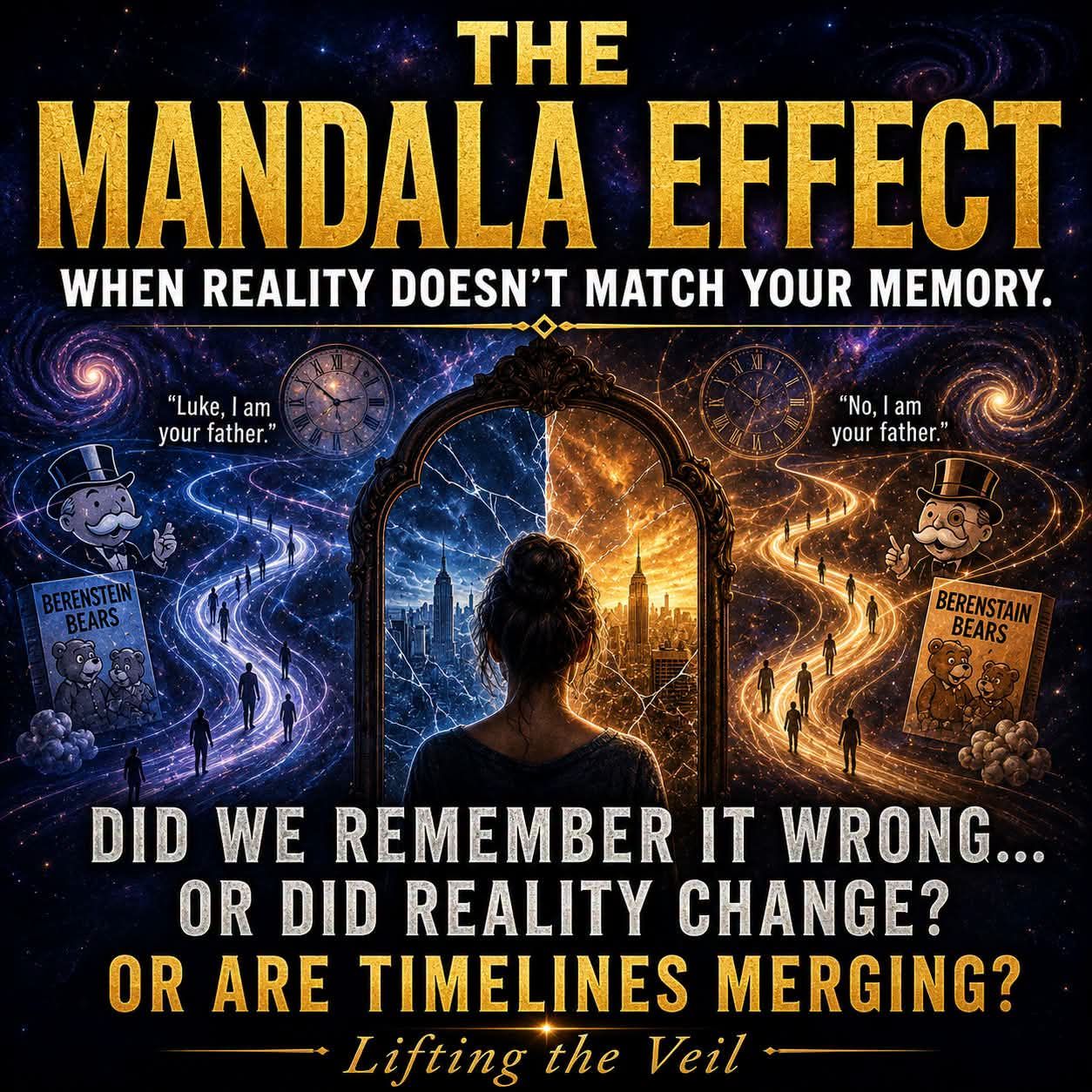
THE MANDELA EFFECT
Are We Remembering Another Timeline?
Have you ever remembered something so clearly that you would have sworn it happened…
only to discover that, according to the historical record, it didn’t?
Not kind of remembered it.
Not maybe remembered it.
But remembered it with the strange certainty of:
“No. I KNOW that happened.”
You remember the scene.
You remember where you were.
You remember talking about it.
You remember seeing it.
You remember the words.
And then someone tells you:
“That never happened.”
Welcome to one of the strangest rabbit holes in modern consciousness:
THE MANDELA EFFECT.
The term was coined by paranormal researcher Fiona Broome after she discovered that other people shared her vivid—but incorrect—memory that Nelson Mandela had died in prison during the 1980s. Mandela was actually released from prison in 1990, became South Africa’s president in 1994, and died in 2013. (Cleveland Clinic)
Since then, thousands of people have reported similar experiences involving movies, books, logos, historical events, famous quotations and other cultural memories.
And this is where things get fascinating.
Because there are two very different ways of looking at the Mandela Effect.
One is psychological.
The other is spiritual.
And today…
we’re going to lift the veil on both.
🧠 THE SCIENTIFIC EXPLANATION
Let’s begin with what we actually know.
Human memory is not a video recording.
Every time we remember something, the brain reconstructs that memory.
Information can become distorted through suggestion, misinformation, confusion about where a memory came from, and repeated exposure to other people’s recollections.
Researchers have demonstrated that false memories can spread through groups and social networks. In other words, people can genuinely come to remember something that didn’t happen—or remember details differently—without intentionally lying.
More recent research has even examined how group discussions can affect memory and found that discussion can increase certain forms of memory distortion and persistence.
So yes…
There is a perfectly legitimate scientific explanation for why groups of people can remember the same thing incorrectly.
But here’s where the conversation gets interesting.
Because knowing how something might happen doesn’t necessarily answer every question people have about their subjective experience.
👁️ WHAT IF THE MEMORY FEELS TOO REAL?
Consider some of the famous examples.
Many people remember the children’s books as the Berenstein Bears.
They were actually the Berenstain Bears.
Many people remember Darth Vader saying:
“Luke, I am your father.”
He actually says:
“No, I am your father.”
Many people remember the Monopoly Man having a monocle.
He doesn’t.
And then there’s one of the most fascinating examples:
Shazaam.
For years, people have described remembering a 1990s movie starring comedian Sinbad as a genie called Shazaam.
People don’t merely say they remember the title.
Some describe scenes.
Characters.
The plot.
The VHS era.
Watching it as children.
And yet no such Sinbad movie has been found in the historical record. Sinbad himself has publicly addressed the memory phenomenon.
There was, however, a real 1996 genie movie called Kazaam, starring Shaquille O’Neal.
So one conventional explanation is that memories of Kazaam, Sinbad’s appearance in other productions, genie imagery and other cultural information became blended together.
That’s entirely possible.
But here’s the question that keeps the Mandela Effect alive:
Why do some people feel so absolutely certain?
🌌 THE SPIRITUAL THEORY
Now let’s step outside conventional psychology.
Not because we are claiming this theory is proven.
It isn’t.
There is currently no scientific evidence demonstrating that people are literally moving between parallel timelines or that alternate realities are merging.
But as a spiritual hypothesis, it is fascinating.
And this is where the Mandela Effect becomes something much larger than:
“Maybe we remembered wrong.”
What if consciousness is not experiencing reality in only one linear way?
What if there are multiple possible timelines?
Multiple versions of events?
Multiple potential outcomes?
And what if, rather than traveling backward or forward through time, consciousness can somehow experience shifts between different versions of reality?
Again…
this is a theory, not established fact.
But let’s explore it.
🌀 THE MULTIPLE-TIMELINE THEORY
Imagine reality not as a single straight line…
but as a vast river.
At certain points, the river divides.
One possibility goes one direction.
Another possibility goes somewhere else.
Another becomes something entirely different.
In one timeline, something happens.
In another, it doesn’t.
In one version of reality, a person makes one decision.
In another, they make a different one.
In one reality, a movie exists.
In another, it never does.
The spiritual theory suggests that perhaps consciousness can move between—or become aware of—different branches of possibility.
And if those timelines begin to converge?
What happens to our memories?
🧬 WHAT IF TIMELINES ARE MERGING?
This is where the Mandela Effect becomes particularly intriguing.
Imagine that two timelines existed independently.
In Timeline A:
Event X happened.
In Timeline B:
Event X did not happen.
Now imagine those realities somehow converging into a single shared experience.
The physical world would contain one version.
But perhaps consciousness could retain fragments from the other.
You wouldn’t necessarily have a complete alternate history stored in your mind.
You might simply have…
a memory that doesn’t match the reality around you.
You might know something differently.
Remember something differently.
Feel something differently.
And yet have no logical explanation for why.
From this perspective, the Mandela Effect wouldn’t necessarily mean that reality has been “changed.”
Perhaps our point of reference has changed.
🪞 WHAT IF MEMORY IS MORE THAN MEMORY?
Here’s where spirituality asks a very different question.
What if consciousness isn’t merely observing reality?
What if consciousness participates in how reality is experienced?
Many spiritual traditions have suggested that reality is not quite as fixed and separate as we ordinarily perceive it.
Quantum physics is sometimes invoked in these conversations, but we need to be careful here.
Quantum mechanics does contain interpretations involving multiple possible outcomes and has inspired serious philosophical discussions about reality.
But there is no established scientific evidence that quantum mechanics proves spiritual timeline shifting or the Mandela Effect.
Those are extrapolations.
Still…
as a spiritual thought experiment?
It’s fascinating.
Because perhaps consciousness itself is much stranger than we currently understand.
🧠 OR ARE WE COLLECTIVELY CREATING REALITY?
There is another possibility.
Maybe there aren’t multiple timelines at all.
Maybe the fascinating thing is what happens when human consciousness interacts with human consciousness.
We tell stories.
We repeat memories.
We share information.
We influence one another.
And eventually, a memory can become collective.
Research actually supports the idea that memories can spread socially and that groups can develop shared false memories.
So perhaps the mystery isn’t:
“Which timeline are we in?”
Perhaps it’s:
“How much of the reality we experience is constructed collectively?”
That’s a pretty profound question by itself.
🌌 BUT WHAT ABOUT THE PEOPLE WHO SAY…
“I KNOW WHAT I REMEMBER.”
This is where I think we need to hold compassion.
A person can be mistaken without being dishonest.
A memory can be inaccurate without being fabricated.
And a person can be completely sincere when they say:
“I remember this differently.”
The feeling of certainty is real.
The memory may not be historically accurate—but the experience of remembering it is absolutely real.
And that distinction matters.
Because the purpose of Lifting the Veil isn’t to tell people:
“This is definitely a timeline shift.”
It’s to ask:
“What if there is more to consciousness than we currently understand?”
🕯️ THE DEEPER SPIRITUAL QUESTION
Maybe the Mandela Effect isn’t actually about proving alternate universes.
Maybe it is reminding us how little we truly understand about consciousness.
We know memory can change.
We know perception can change.
We know collective beliefs can change.
We know societies can remember history differently.
And we know our understanding of reality continues to evolve.
So perhaps the Mandela Effect is an invitation to remain curious.
Not gullible.
Not blindly believing every internet theory.
But curious.
Because there is a difference between saying:
“This theory is true.”
and saying:
“What if?”
And sometimes…
“What if?”
is where exploration begins.
🌀 WHAT IF WE AREN’T CHANGING TIMELINES?
Here’s another thought.
Perhaps we aren’t jumping between timelines.
Perhaps we are simply becoming conscious of possibilities that were always there.
Maybe reality is more like an ocean of potential than a single railroad track.
Maybe every choice creates another possibility.
Maybe consciousness experiences reality through a particular pathway.
Maybe what we call intuition is our awareness of possibilities before our logical mind can explain them.
And maybe the Mandela Effect fascinates us because it forces us to confront an uncomfortable truth:
Our perception of reality is not reality itself.
There is always a veil.
👁️ LIFTING THE VEIL
So…
Are the Mandela Effects proof that timelines are merging?
No.
We don’t have evidence to say that.
But does that mean we have answered every philosophical question about consciousness, perception, memory and reality?
Not even close.
And that’s where I want to leave you.
Not with an answer.
With a question.
Because perhaps the most interesting part of the Mandela Effect isn’t determining whether reality changed.
Perhaps it’s discovering just how much of reality…
we never fully understood in the first place.
Maybe some memories are simply memories.
Maybe some are beautifully constructed mistakes.
Maybe some are the result of collective consciousness.
Maybe we are merging timelines.
And maybe—just maybe—there are aspects of consciousness and reality that we haven’t developed the language to understand yet.
We don’t have to decide today.
We can simply observe.
Question.
Explore.
And remain open.
Because sometimes…
lifting the veil doesn’t reveal an answer.
Sometimes…
it reveals another question behind the first one.
🌌 SO I WANT TO ASK YOU:
What is your strongest Mandela Effect?
What is something you remember with absolute certainty…
that the world around you insists never happened?
Tell me your story.
Let’s compare memories.
And perhaps somewhere in the space between all of our memories…
we’ll discover something worth exploring.
 Apostolic Pentecostal Network
You must be logged in to post a comment.